

I spent most of my working life leaning over patients. Twenty-six years as a dental hygienist will round your shoulders and push your head forward whether you want it to or not, and now that I sit at a front desk three days a week, I feel the bill every afternoon. The tight spot between my shoulder blades shows up around two, my neck complains on the drive home, and by the time I settle into my recliner I am a comma. So when I decided to try a posture corrector, I ordered two of the most talked-about ones at once: the Schiara Posture Corrector and the ComfyBrace Posture Corrector. I wore each for three weeks straight, through desk days, grocery runs, and a two-hour drive to visit my daughter in Cincinnati. Here is the short answer: if you need something to wear under a work shirt for eight hours, the Schiara is the one I kept reaching for.
The ComfyBrace is not a bad product. It pulls harder, and some people want that. But a desk day is a marathon, not a sprint, and the Schiara disappeared under my clothes in a way the ComfyBrace never did. It did not dig in when I leaned toward my keyboard. It did not bunch up when I turned to grab a file. And at the end of the day, my shoulder blades felt looser, not just reminded. That is the whole argument in one sentence: the Schiara is the one you will actually wear.
Why I Even Bought a Posture Corrector
For years I told myself my posture was fine. I had been a dental hygienist for two and a half decades, and leaning over a chair all day is just what the job is. You angle your head, you reach, you twist, and you do it again for the next patient. It was not until I moved to a front desk job that I noticed how much time I spent with my shoulders curled forward. By two in the afternoon I would catch a glimpse of myself in the hallway mirror and wonder who that rounded person was.
I am not a doctor and I am not a physical therapist, so I will say plainly what my limits are. I can tell you what I felt, what fit, and what I kept wearing. I cannot tell you that a brace will fix your spine, and I would not trust anyone who promised that. What I wanted was a reminder, something that would nudge my shoulders back into place while I sat at a laptop or drove the two hours to Cincinnati to see my daughter. That is the job I was hiring for.
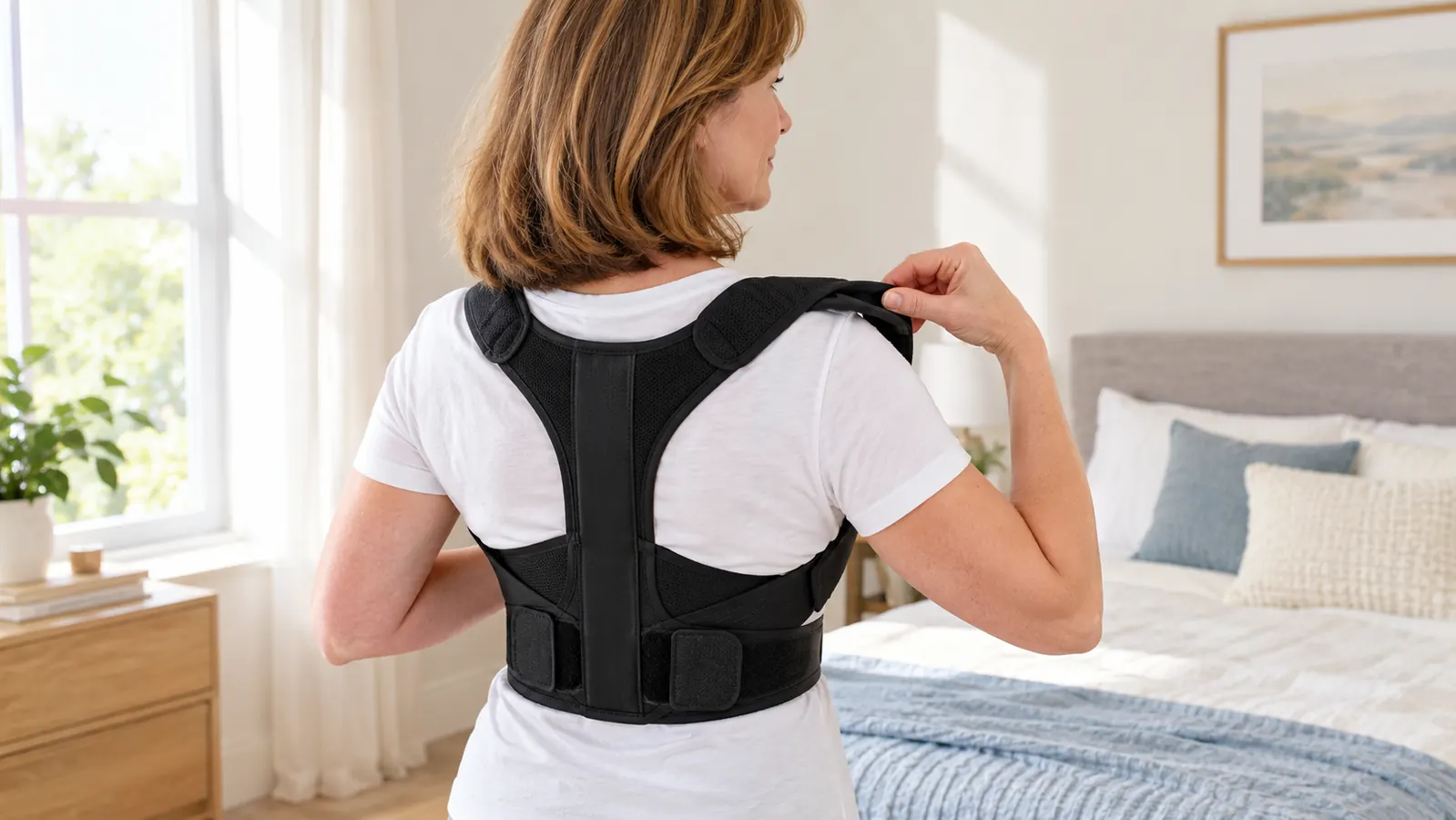
The Two Braces, Side by Side
I ordered both at the same time so I could test them under the same conditions. Here is how they compare on the things that actually decided it for me.
| Schiara Posture Corrector | ComfyBrace Posture Corrector | |
|---|---|---|
| Fit | Sized by chest measurement, with front and back adjustments | One size with a hook and loop closure, quick but less precise |
| All-day comfort | Soft edges lie flat under a work shirt, easy to forget | Thicker padding that bunches and feels warm by mid-afternoon |
| Ease of putting on | Slip your arms through, then snug the front strap, no mirror needed | Wraps around and fastens behind your back, awkward with stiff shoulders |
| Strength of pull | Firm, gradual pull that reminds you to sit up | Stronger immediate pull that forces your shoulders back |
| Simplicity | Multiple adjustment points to dial in | One strap, one size, nothing to fiddle with |
| Best for | Desk days, long drives, all-day wear under clothes | Short sessions and a firmer nudge |
How I Put Them to Work
I did not do anything scientific. I wore the Schiara for three weeks on my front-desk days, then switched to the ComfyBrace for three weeks, then went back to the Schiara for a final week to make sure I was not just missing the novelty. Same chair, same keyboard, same two-hour drive to Cincinnati on the weekends. I kept a little notebook in my desk drawer and wrote down the time of day my shoulder blades started complaining. With the Schiara, that tight spot usually did not show up until after five. With the ComfyBrace, it was usually around three.
One thing I learned fast: a posture corrector only works if you put it on, and you only put it on if it does not fight you. The ComfyBrace pulled harder, which felt great in the moment, but by hour three I was loosening the strap and by hour five I had taken it off in the bathroom. The Schiara never made me want to take it off. That is the whole test, really.
I also paid attention to how each brace behaved when I was not thinking about it. Did it ride up when I reached for a file? Did the edges dig in when I leaned toward the keyboard? Did I have to excuse myself to the restroom to fix it? The Schiara stayed where I put it. The ComfyBrace needed attention by mid-afternoon, and a brace that needs attention is a brace you will eventually stop wearing.
Wearing It on the Drive to Cincinnati
The desk was one test, but I drive a 2016 Honda CR-V and my daughter lives about two hours away, so the car was the other test. My neck gets stiff on long drives, and my shoulders have a habit of curling toward the wheel. I wore the Schiara on the way down and the ComfyBrace on the way back, same route, same traffic, same seat.
The Schiara did not save me from the drive, and I would not expect it to. But I noticed I was not gripping the wheel with my shoulders up around my ears. I got out of the car in Cincinnati and my upper back did not feel like a knot. The ComfyBrace on the return trip pulled harder from the start, and I loosened it at a rest stop around the middle of the trip. By the time I pulled into Columbus I had taken it off entirely.
Where Schiara Wins
The Schiara wins on the things that matter over a ten-hour day. The fit is the big one. It comes in chest sizes rather than a single stretchy tube, so the band sits at the right spot on my rib cage and the shoulder straps land where my shoulders actually are, not where a mannequin's would be. I could adjust the front strap without taking the brace off, which meant I could ease the tension at two in the afternoon and snug it back up after lunch. That kind of fine control is what makes a brace wearable instead of a thing you tolerate.
It also wins on staying put. The edges are soft and lie flat, so nothing dug into my arms when I reached for the phone or the file cabinet. Under a cotton work shirt, nobody could tell I was wearing it. I washed it twice a week, hung it to dry, and it came out the same shape every time. After six weeks of on-and-off wear, the elastic still has its snap, and the straps have not stretched into uselessness the way cheaper braces do.

Where ComfyBrace Wins
I want to be fair, because the ComfyBrace does some things better. It pulls harder, and for a short session that is genuinely useful. If you want to wear a brace for twenty minutes while you answer email, or you want a strong reminder the moment you stand up straight, the ComfyBrace gives you that. My husband Dave, a retired mail carrier with his own lower-back complaints, tried both and preferred the ComfyBrace for exactly that reason. He wanted to feel it working. He wore it for half an hour after supper and liked the firmness.
It is also simpler. One size, one strap, no measuring. If you are buying a brace as a gift, or you do not want to think about fit, the ComfyBrace is easier to get into. The stronger pull means you notice it more, which some people read as the brace working harder. That immediacy has real appeal. It just does not hold up for eight hours at a desk, and that is the job I needed done.
The brace that survived my desk day
After six weeks of switching back and forth, the Schiara is the one I reach for on work mornings. It fits under clothes, stays comfortable past five o'clock, and still holds its shape after repeated washings.
Amazon Check Today's Price on Amazon →Who Should Buy Which
Buy the Schiara if your posture problem shows up the way mine does: after hours of sitting, when your shoulders creep forward and the space between your shoulder blades starts to burn. It is the brace for people who need to wear something all day and forget it is there. Buy the ComfyBrace if you want a strong, simple reminder for short stretches, or if you would rather not measure anything and you do not mind a firmer pull. There is room for both in a drawer. If I could only keep one, it would be the Schiara.
And one honest note: neither brace fixed my posture. What they did was remind me to sit up, and over a few weeks that reminder trained me to notice when I was slumping. If you have real pain, talk to a doctor or a physical therapist. I am not either one. I am just someone who spent twenty-six years leaning over patients and finally decided to do something about the slouch.
If you are still deciding, think about your worst hour. Mine is four in the afternoon, when I have been sitting for six hours and the tight spot between my shoulder blades is talking to me. That is the hour the Schiara got me through. If your worst hour is the first ten minutes after you stand up, and you want a brace that announces itself, the ComfyBrace may suit you better. Neither answer is wrong. They are just different jobs.
With the Schiara, the tight spot between my shoulder blades did not show up until after five. With the ComfyBrace, it was usually around three.
What Nobody Tells You About Posture Correctors
Here is what I did not expect: wearing a brace made me notice how often I slouch, and noticing is most of the battle. The brace is not doing the work at hour six. By then my muscles are tired and the brace is just a gentle witness. But because I had worn it all day, I had practiced sitting up all day, and that practice carried over to the days I did not wear it.
The other thing nobody tells you is that a brace can be too strong. The ComfyBrace's firm pull felt like a workout, and there is something to that. But a correction you cannot wait to take off is a correction you will not wear consistently, and consistency is what changes a habit. The Schiara's gentler pull meant I wore it longer, and wearing it longer did more for my afternoon slouch than any stronger tug ever did.
The Bottom Line
I tested both braces the same way, on the same chair, over the same six weeks, and the difference came down to one question: which one would I still be wearing at four in the afternoon? The Schiara. It fits better, breathes better, and disappears under my shirt in a way the ComfyBrace never managed. The ComfyBrace has the stronger pull and the simpler strap, and for short sessions it is a perfectly good tool. But for a desk day, week after week, the Schiara is the one I would buy again.
I keep the ComfyBrace in the drawer for the days I want a firmer nudge, and I reach for the Schiara on work mornings. If you only want one, buy the one you will wear, and the one I wore was the Schiara. It fits under a work shirt, it stays comfortable past five o'clock, and after six weeks of washing it still holds its shape. That is the whole review.
Give your desk day a fair test
Try the Schiara on a normal work morning and see if you are still wearing it after lunch. That is the test that settled it for me.
Amazon Check Today's Price on Amazon →