

I noticed it the same way I notice most of my aches: slowly, then all at once. Thirty years of leaning over patients as a dental hygienist, then a few more years hunched over a laptop at my spare-bedroom desk, and somewhere in there my shoulders decided to live in front of my ears. By mid-afternoon I had a tight spot between my shoulder blades, and after a two-hour drive to my daughter's place in Cincinnati, my neck was stiff enough that I'd spend the first evening rolling it against the headrest of my 2016 CR-V. My husband Dave, a retired mail carrier, just nodded when I complained. He has his own lower-back complaints and knows better than to compare. By the time I ordered the Schiara Posture Corrector, I was ready to try anything that didn't involve nagging.
I did the usual things first. I tried to remember to sit up, which worked for about four minutes. I stacked a pillow behind my lower back, which helped until I forgot the pillow was there. I even asked Dave to point it out when he saw me slouching, and he did, bless him, about eleven times a day, until we were both tired of it. The problem was never that I didn't know I was slouching. The problem was that I only noticed after I'd been slouching for half an hour.

So when the Schiara brace arrived, I wasn't expecting a cure. I wasn't expecting it to undo thirty years of bad habits in a week. I ordered it because I needed something to remind me, the way Dave does, but without the commentary.
This is the story of what happened when it showed up, and what I would tell you if we were sitting at my kitchen table.
The brace didn't fix my posture. It just made me notice when I was slouching, and that turned out to be most of the battle.
If you spend your days hunched over a laptop, this is the reminder I wish I'd had years ago
The Schiara Posture Corrector is the brace I reach for on desk days. It pulls my shoulders back without digging in, and it's adjustable enough that I can wear it over a t-shirt or a thin sweater.
Amazon Check Today's Price on Amazon →The first time I put it on, I laughed. It felt like someone had gently grabbed my shoulders and rolled them back, which is exactly what I'd been trying to do on my own for years. The straps crossed between my shoulder blades and the band sat across my upper back without digging into my armpits, which was my big worry. I'm a 54-year-old woman who spent 26 years leaning over patients, and I have zero patience for anything that pinches.
What surprised me wasn't the brace itself. It was how quickly I stopped thinking about it. I wore it for an hour the first day while I paid bills at my desk, and I forgot it was there until I stood up and felt the difference. My shoulders stayed back the whole time, not because the brace was forcing them, but because it was reminding me, every few minutes, that I was slouching again. That gentle tug was enough to make me sit up without making a project out of it.
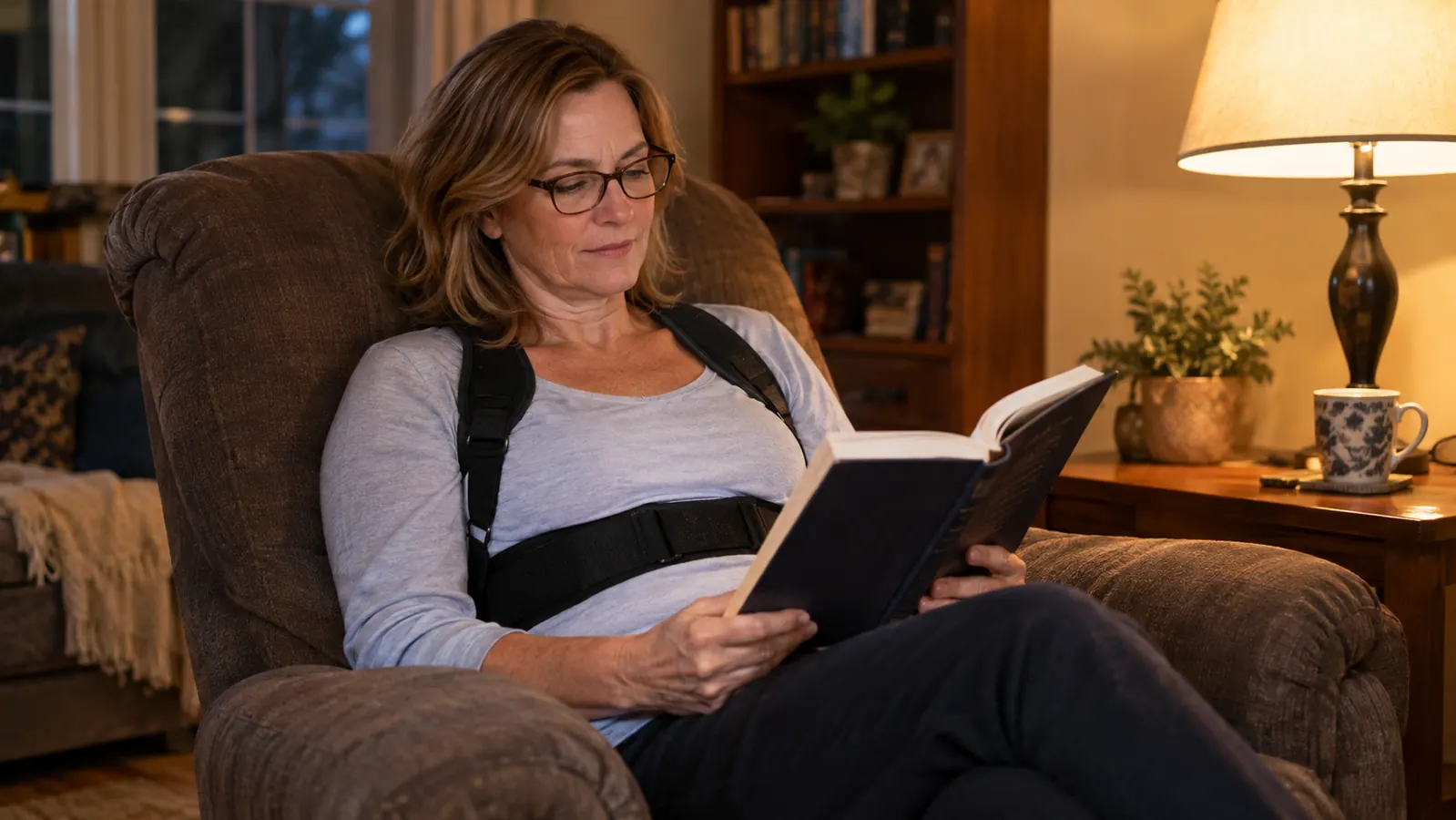
By the second week I had a routine. I wore the Schiara brace for the first couple of hours at my front-desk job, took it off for lunch, and put it back on for the afternoon. On my days off I wore it while I wrote at my spare-bedroom desk, and once, on a long drive to Cincinnati, I wore it in the car. That last one surprised me. I expected a brace to be the last thing I'd want on a two-hour drive, but the support behind my shoulders meant I wasn't gripping the wheel with my neck, and I pulled into my daughter's driveway with less stiffness than I'd had in months.
One afternoon stands out. I had a stack of paperwork at the front desk and a phone call that ran long, the kind of day that usually ends with me rolling my shoulders in the parking lot. When I stood up to leave, my back felt normal. Not fixed, just normal, and that was enough to make me put the brace on again the next morning.
Now, the honest part. The Schiara Posture Corrector is not a cure, and it is not something I wear all day. It's a reminder. Some days I put it on and my shoulders stay back for hours. Other days, usually the days I'm tired or stressed, I take it off by noon and slouch in my recliner that night anyway. I'm not a physical therapist and I'm not going to pretend to be one. If you have real pain, please check with one. But for the specific problem I have, rounded shoulders and a forward head from decades of leaning in, this brace does what I needed it to do. It reminds me.
What I'd Tell You If We Were Sitting at My Kitchen Table
Here's what I'd say, plain and simple. If you're thinking about a posture corrector, buy one that you'll actually wear, and the Schiara brace is the one I actually wear. It's adjustable, it doesn't dig in, and it works over whatever I'm wearing, which means I don't have an excuse to skip it. I'd also tell you to start slow. Wear it for an hour, then two, and don't expect it to fix a decade of slouching in a week. That's not what it's for.
I'd tell you that the best part isn't the way it looks or the way it feels when you first put it on. It's the moment, two hours into a workday, when you realize your shoulders are still back and you haven't thought about them once. That's the moment I bought it for.
The brace that reminded me to sit up, and still does most days
If my story sounds like your mornings, the Schiara Posture Corrector is worth a try. It's comfortable enough to forget, adjustable enough to fit under your clothes, and honest about what it can't do.
Amazon Check Today's Price on Amazon →