By the time I hit my mid-fifties, I could set a clock by my neck. Three hours into a workday, first leaning over patients for twenty-six years as a dental hygienist and now working a front desk three days a week, and the stiffness would settle in right between my shoulder blades. Long drives made it worse. A two-hour trip to see my daughter in Cincinnati and I'd arrive with my head tilted like I'd been in a wind tunnel, rolling my shoulders in the parking lot before I could walk into her house. I'd gotten so used to it that I mostly stopped mentioning it. It was just part of getting older, or so I told myself.
I tried the usual things first. A rolled-up towel behind my neck. Morning stretches on the living room rug. A fancier pillow that cost more than I care to remember. They all helped for about a week, then stopped, and each one ended up in a closet. So when I ordered the RESTCLOUD neck stretcher, I wasn't expecting a cure. I was expecting a foam brick that would join the others. Eight months later, it's still on the floor next to my recliner, and I reach for it most days. That surprised me, and it's why I'm writing this.
The Quick Verdict
The RESTCLOUD gives real, consistent relief for everyday neck tension. It's not a cure, and it's not for people in serious pain, but it earned a permanent spot on my living room floor.
Amazon Check Today's Price →The neck stretcher I've used almost daily for eight months
If your neck tightens by mid-afternoon or after a long drive, this is the one I keep coming back to. It's simple, it's consistent, and it's still sitting next to my recliner. See today's price on Amazon.
Amazon Check Today's Price on Amazon →How I've Used It
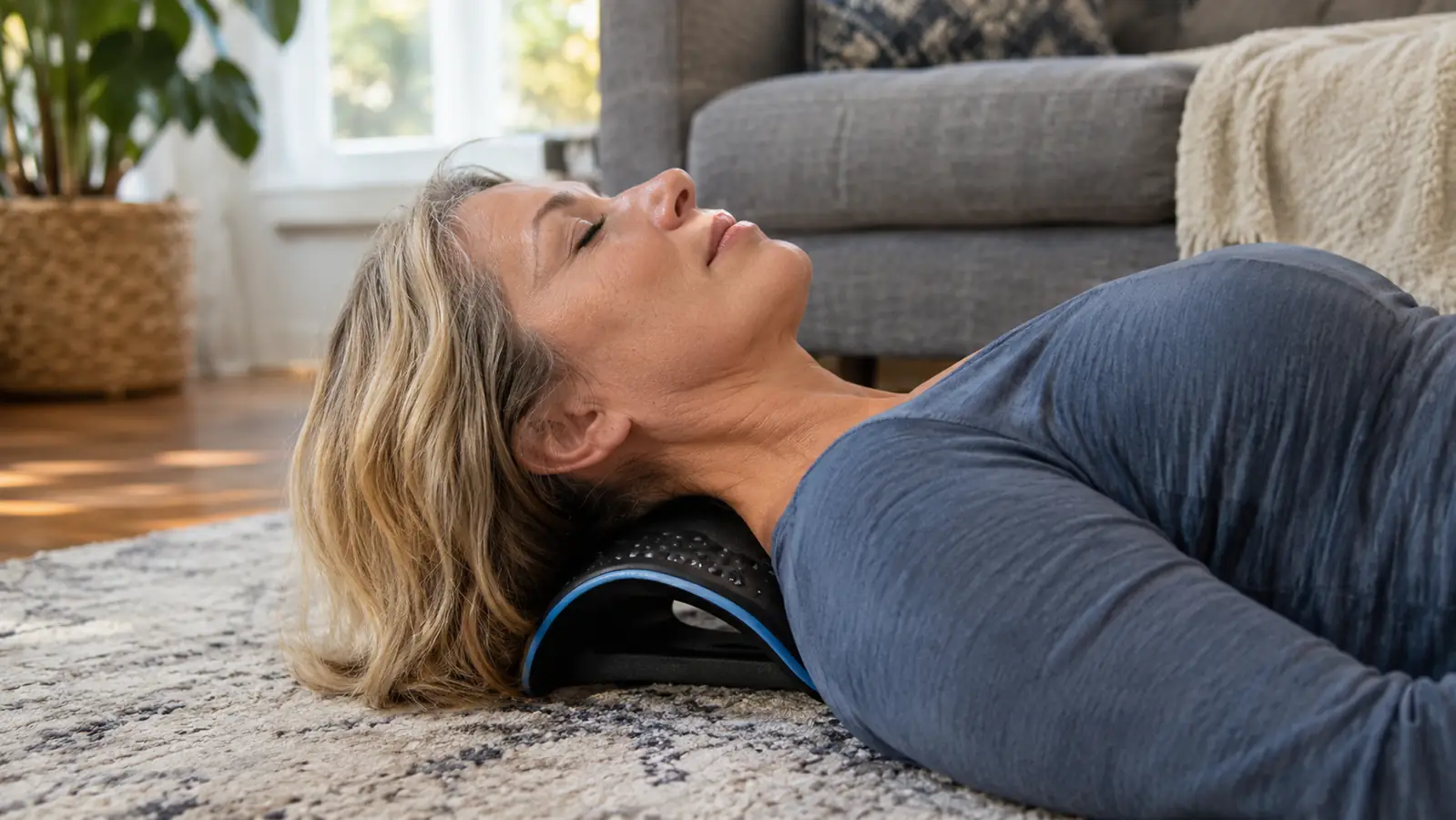
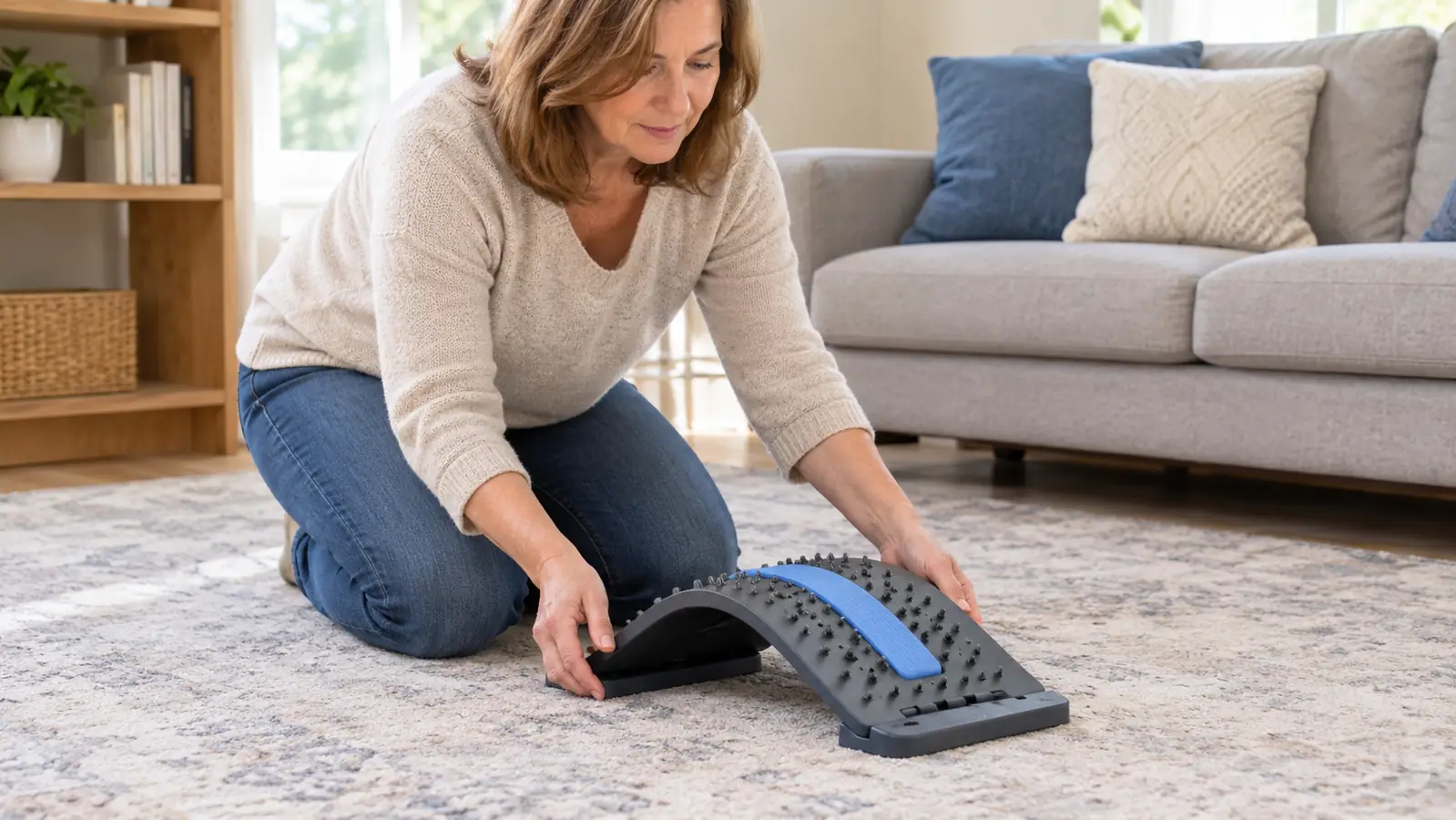
The RESTCLOUD is a molded piece of firm foam with a curve that cradles the back of your neck when you lie on the floor. You position it so the curve sits under the base of your skull, let your head relax back, and then you just lie there. That's the whole motion. No straps, no inflation, no charging cord, nothing to assemble, nothing to read before you start. I opened the box, glanced at the single page of instructions, and used it that same evening while I watched the news. I remember thinking it was almost too simple to work.
My routine has been boring on purpose. Most evenings I lie on the living room rug for ten or fifteen minutes while I listen to a podcast on my phone. The first week, five minutes was plenty. The stretch is gentle, but it's also unfamiliar, and my neck let me know it was being asked to do something different. I built up slowly, adding a minute or two each session, and that patience paid off. By the end of the first month I could do a full fifteen minutes without wanting to shift. I kept the RESTCLOUD in the same spot every night, which sounds like nothing, but it meant I didn't have to decide anything. It was just there, and I used it.
I also use it after long drives. The trip to Cincinnati is about two hours each way in my 2016 Honda CR-V, and I used to arrive stiff and cranky, with that familiar tightness between my shoulder blades. Now I'll pull the Restcloud out when I get home, lie down for a few minutes, and the stiffness that used to live in my neck for the rest of the day mostly doesn't show up. It's not magic. It's just consistent, and consistency is the part I've always struggled with. I've even brought the Restcloud along on a visit to my daughter's place, since it's light enough to toss in a bag.
What the Restcloud Neck Stretcher Actually Does
The idea behind a cervical traction device is simple, and it's worth understanding before you buy one, because it explains why a piece of foam can do anything at all. Your neck spends all day holding your head in whatever position your habits dictate. For a lot of us, that means a forward head, rounded shoulders, and muscles that stay quietly clenched even when we think we're relaxed. When you lie on a curved support, the back of your neck gets to stretch out, and the muscles at the base of your skull get a chance to finally let go. It's not a stretch you perform. It's a position you hold, and the position does the work.
The RESTCLOUD does this with a fairly firm foam base and a contour that tilts your head back just slightly. It's not aggressive. If you've used an inflatable traction device, the sensation is different. The inflatable ones let you dial up the pull with a pump. This one gives you a single setting, and the setting is gentle. For some people that's a drawback. For me it turned out to be the reason I kept using it.
What I appreciate most is that it doesn't require technique. There's no pump, no valve, no guessing at pressure, no right way to hold your arms. You put it on the floor, lie down, and shift your head until it feels right. For someone who doesn't want to think about a device, that's the whole appeal. I have enough routines in my life. I didn't want another one with a learning curve. The learning curve here is basically zero, and for a gadget that's supposed to help you relax, that matters.
What Held Up Over Months of Use
I was skeptical about durability. Foam products have a way of going soft, and I've owned pillows that collapsed into pancakes within a year, plus a foam roller that developed a permanent dent. The RESTCLOUD has held its shape through eight months of near-daily use. The firmness hasn't changed, and the surface still looks the way it did the day it arrived. I've dropped it, leaned on it, and once left it on the floor where Dave stepped on it. It didn't care. I can't promise yours will do the same, but mine has.
Cleaning has been easy, which matters more than you'd think for something that lives on the floor. I wipe it down with a damp cloth and let it air dry. When the cover needs a deeper clean, it comes off and goes in the washing machine on a gentle cycle. I've done that twice now, and it's come out fine both times.
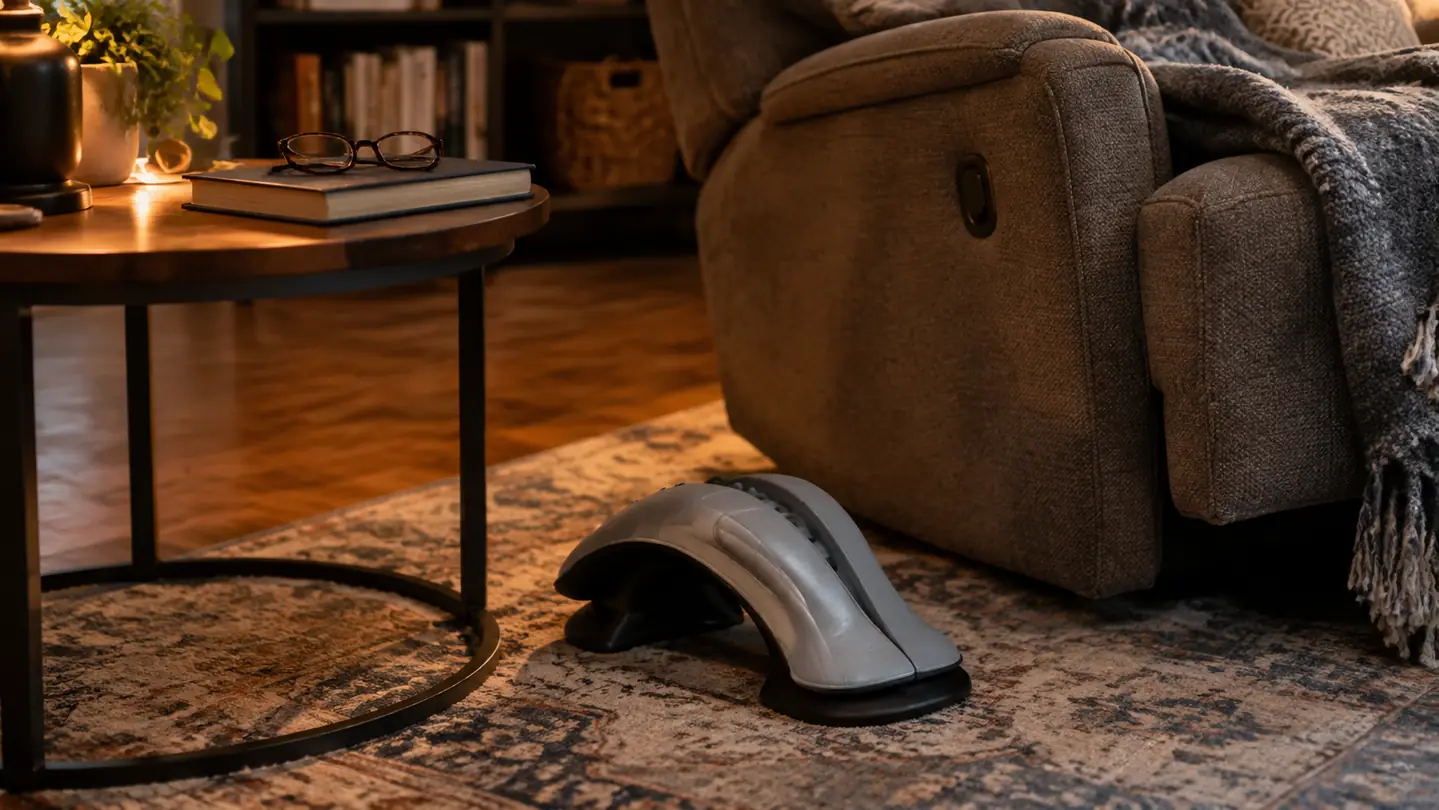
It also doesn't take up space. It lives beside my recliner, where I can see it, and I don't trip on it. That sounds like a small thing, but every other posture gadget I've owned required a drawer or a closet shelf, and out of sight meant out of mind. This one just sits there, visible, and because it's visible, I actually use it. That alone set it apart from everything else I've tried.
What Bugged Me
Let me be honest about the parts I didn't love, because every review should have some. The first is the firmness. The RESTCLOUD is not a soft pillow. If you're used to sinking into memory foam, the first few sessions will feel intense, and I don't think that's a bad thing, but it is a thing. I had to start with five minutes and work up, and during the first week I wasn't sure I'd stick with it.
The second is positioning. It takes a few tries to get the curve in the right place. Too high and it presses on the wrong part of your skull. Too low and you're basically lying on a wedge doing nothing useful. After about a week I found the spot without thinking about it, but it's not something you nail on the first try. It's the kind of adjustment that becomes automatic, but only if you give it the week. If you're the kind of person who gives up on something after one awkward session, you'll need to push past that first week.
The third is that it does nothing for you when you're not using it. The relief I get is real, but it lasts hours, not days. If I skip a few days, the tight spot between my shoulder blades comes back by mid-afternoon, right on schedule, and I'm back to rolling my shoulders at my desk like I never owned the thing. This is a maintenance tool, not a one-time fix. It works because I keep using it, and the moment I stop, my neck goes back to its old habits.
What I Can Honestly Report After Months
I don't want to oversell this. My neck is not transformed. I still have rounded shoulders, and I still catch my head drifting forward when I'm tired or focused on a screen. But I can report specific things, and specific things are what I actually care about.
The tight spot between my shoulder blades, the one that used to show up reliably by two in the afternoon, shows up less often and less intensely. The drive to Cincinnati no longer leaves me stiff for the rest of the day. And I've stopped waking up with a crick in my neck on the mornings after I've used it before bed. Those are three concrete changes, and I noticed all three within the first couple of months, before I'd decided whether I even liked the thing. None of these are dramatic. I'm not running marathons. But they're the difference between a neck that nags at me and a neck that mostly leaves me alone.
I also handed it to Dave, my husband, who has his own complaints, mostly lower back. He tried it once, said it felt strange, and handed it back. So it's not for everyone, even in my own house. For me, the consistency is the win. Most days I use it, and most days I'm glad I did. That's a better track record than any other posture product I've owned.
What I Liked
- Simple to use: lie down, adjust your head, relax
- Held its shape through eight months of near-daily use
- Genuinely helped the tight spot between my shoulder blades
- Easy to clean and small enough to leave out where I can see it
- Gentle enough for daily use, firm enough to feel like it's doing something
Where It Falls Short
- Firm foam takes getting used to; the first sessions can feel intense
- Positioning is fiddly until you learn the right spot
- Relief lasts hours, not days; it's a maintenance tool, not a fix
- One setting only, with no way to adjust the stretch
- Not for anyone with real neck pain or an injury
Eight months in, the RESTCLOUD is the only posture gadget I've ever kept out in the open, and the only one I use most days.
Who This Is For
This is for people who carry everyday tension in their neck and shoulders. Desk workers, people who spend hours looking down at a phone, anyone whose neck stiffens on long drives. It's for people who want something simple and passive, a device you lie on for ten minutes rather than a routine you have to learn and maintain.
If you've tried stretching and it helped a little but you couldn't keep it up, the low barrier here is the point. You don't have to remember a sequence or find a class or set aside a workout. You just lie down. That's why it stuck for me when other things didn't. The best posture tool is the one you'll actually use, and this one is easy to use.
I'd also say it's for people who are tired of buying products that require them to change their life. The RESTCLOUD didn't ask me to meditate, or stretch for twenty minutes, or use it at a specific time of day. It asked me to lie down for ten minutes. That's a low enough bar that I actually cleared it, most days, for eight months.
Who Should Skip It
Skip it if you're in real pain. I'm not a doctor or a physical therapist, and I'll say it plainly: if your neck hurts when you move it, or you have an injury, a diagnosis, or any kind of acute problem, don't take my word for anything. Check with a professional first. I'd rather you be annoyed that I told you to see a professional than sorry I didn't. This is a comfort tool for everyday tension, not a treatment for anything serious.
Skip it if you want something you can dial in. The RESTCLOUD has one position and one level of firmness. If you know you want adjustable traction, an inflatable device gives you more control, at the cost of more fuss and more parts to manage. And skip it if you already have a routine that works. This isn't better than a good stretching habit. It's just easier to keep.
And if you need to feel a strong pull to believe something is working, the gentleness here might read as weakness. I've seen reviews from people who found it too mild. I understand that. It's a subtle tool, and subtle doesn't work for everyone.
The one I kept using when the other gadgets went in the closet
If everyday neck tension is your problem, this is the simple, consistent tool that worked for me. It's still on my floor eight months later. Check today's price on Amazon.
Amazon Check Today's Price on Amazon →