

I bought the Schiara Posture Corrector the same way most people do: I got tired of my own reflection. Twenty-six years of leaning over dental patients left me with rounded shoulders and a head that drifts forward, and by three in the afternoon there was a tight knot between my shoulder blades that no amount of stretching seemed to touch. So I ordered one, wore it for six weeks, kept a little notebook, and now I am going to tell you the things the product page leaves out.
The short version: it is a genuinely comfortable brace, it does pull your shoulders back, and it costs less than most of the competition. It is also not a fix for anything on its own, the sizing is less forgiving than the listing suggests, and if you have real shoulder or neck pain you should talk to a doctor before you spend a dime on any of this. Let me explain.
The Quick Verdict
A comfortable, well-made posture brace that does what it claims, as long as you understand it is a reminder, not a cure.
Amazon Check Today's Price →The posture corrector I kept reaching for after six weeks
The Schiara pulls your shoulders back without digging into your armpits, and it is light enough to forget you are wearing it. That is the whole job, and it does it well.
Amazon Check Today's Price on Amazon →How I Tested It
I wore the Schiara for six weeks, starting in early March. Most days I put it on at eight in the morning and took it off around five, which means I wore it through front-desk shifts, long drives in my 2016 Honda CR-V, and plenty of evenings at my little desk in the spare bedroom. I washed it by hand every Sunday, kept notes on fit and comfort, and I did not change anything else about my routine. No new exercises, no standing desk, no posture app. I wanted to know what the brace alone would do.
I should be clear about who I am here. I am Marla Kincaid, I am 54, and I spent 26 years as a dental hygienist leaning over patients. I now work three days a week at a front desk in Columbus, Ohio. I am not a doctor, I am not a physical therapist, and if you are in real pain, the right move is to get checked out before you buy anything. What I can give you is an honest account of what this brace feels like day to day, what it did and did not do for me, and the things I wish someone had told me before I ordered it.
A typical day looked like this: I put the brace on over a cotton t-shirt right after breakfast, then drove the ten minutes to the front desk where I work three days a week. I sat at the reception counter answering phones and checking people in, and by ten o'clock I would notice the brace gently reminding me to roll my shoulders back. At lunch I loosened the front panels a half inch, because the brace does tighten up as you move around. On the days I did not work, I wore it at my desk in the spare bedroom while I paid bills and answered email, and I even wore it one rainy Saturday while I cleaned out the hall closet. The notebook was simple: date, hours worn, and one line on how my shoulders felt by evening. After the first week, the line most days read 'forgot it was on,' which told me more than any mirror could.
The first week was the hardest, and nobody tells you that. The Schiara is not a punishing brace, but your body has spent decades slouching, and it will complain when you stop. My shoulders ached by evening for the first four or five days. My husband Dave, a retired mail carrier, tried it on one afternoon and said it made his lower back feel better, which is not what I expected from a device aimed at the upper back. By the end of week two, the ache was gone and I could feel the brace doing its job without thinking about it.
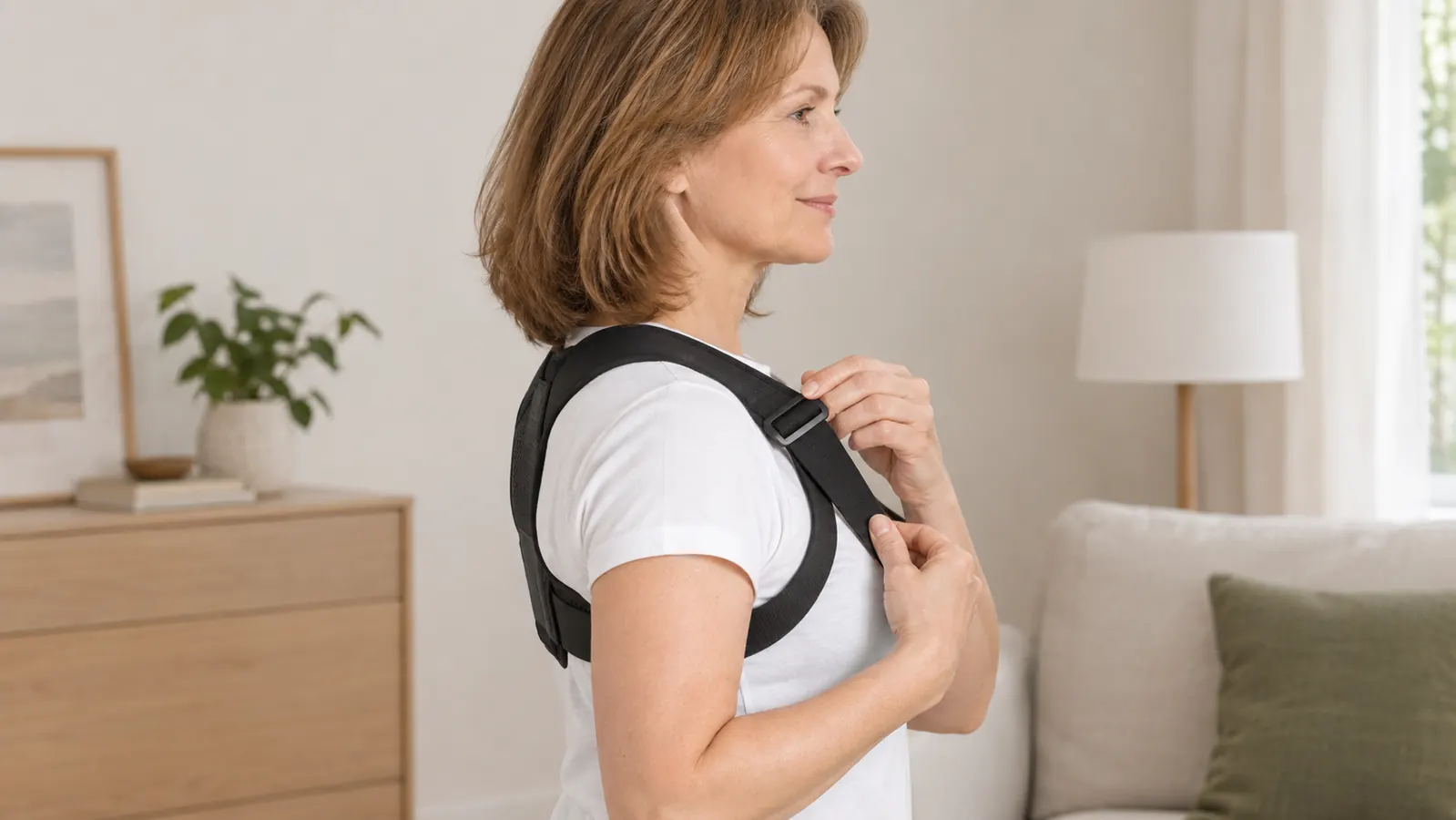
What the Schiara Posture Corrector Actually Does
The Schiara is a soft, adjustable brace that wraps around your upper back and pulls your shoulders into a more open position. The straps cross behind you and fasten with velcro panels on the front, and you can tighten or loosen them by degrees, which matters more than you would think. A brace you can adjust while you are wearing it gets used. One that requires taking the whole thing off to change the fit gets abandoned by Tuesday.
The material is the part that surprised me. For a brace in this price range, the Schiara feels genuinely nice. The padding is soft against your skin, the edges do not curl or dig in, and the whole thing is light enough that I forgot I was wearing it by mid-morning. That is the single most important quality in a posture brace, because a brace you forget you are wearing is a brace you will actually wear. The Schiara is not the most supportive brace I have tried, but it is the easiest to live with.
Here is the part the listing does not tell you. The Schiara does not hold you in perfect posture. It reminds you. When it is on, you feel the pull the moment you start to slouch, and that gentle tug is enough to make you straighten up. But the moment you take it off, your muscles go right back to their old habits. I wore mine for six weeks and I can honestly say my posture did not permanently change. What changed was my awareness of my posture. That is a real benefit, but it is not the same thing as a fix.
I tested the pull the way I test most things, by being skeptical. On the third day I wore the Schiara under a cardigan and stood at the bathroom mirror, and I could see my shoulders sitting back in a way they had not done in years. Then I deliberately slouched, the way I do at night in my recliner, and I felt the straps tighten across my shoulder blades within seconds. That is the whole mechanism. It does not yank you upright like the rigid back braces from the drugstore. It just makes slouching feel wrong, which is a clever trick, because your body will do almost anything to avoid an uncomfortable feeling. The velcro front panels let me fine-tune that tension through the day: looser in the morning, a half inch tighter after lunch when I started to slump.
The brace does not hold you in perfect posture. It reminds you. That sounds like a small difference, but it is the whole difference.
Sizing, Fit, and What Nobody Tells You
The Schiara comes in a few sizes, and the fit is less forgiving than the listing suggests. I am 5 foot 6 and about 150 pounds, and the medium fit me well. My husband Dave, who is broader across the shoulders, needed the larger size, and even then the velcro panels barely met. If you are between sizes, size up. A brace that is too small will ride up, bunch at the armpits, and end up in a drawer by the end of the week.
Measuring was the part I almost got wrong. The listing's size chart asks for your chest measurement, not your shirt size, and that caught me off guard. I pulled the tape measure around my ribcage and came up with 36 inches, which put me at the top of the medium range. Dave measured 44 inches and needed the large, and even then the velcro panels met with only a couple of inches to spare. If I had sized down to squeeze into a small, I am certain I would have quit by day three. And if Dave had ordered the medium he normally wears in shirts, he never would have gotten the panels to close at all. The lesson I took from both of us: measure first, trust the chart, and do not assume your shirt size means anything.
The other thing nobody tells you is that the brace shows under clothes. The listing photos make it look sleek and invisible, and it is, under a loose sweater or a cardigan. Under anything fitted, you will see the straps at your shoulders and the band across your back. That is not a flaw, it is just physics, but I wish I had known before I wore it to work under a knit top and spent the day feeling self-conscious. If you plan to wear it at the office, plan your wardrobe around it.
Washing is easier than I expected. The Schiara is hand-wash only, and it dries overnight if you hang it. I washed mine every Sunday for six weeks and it held up fine. No frayed edges, no velcro that stopped grabbing, no smell that would not come out. That is more than I can say for a cheaper brace I tried a couple of years ago, which fell apart in the wash after a month.
The Results After Six Weeks
Here is my honest report card. My afternoon shoulder-blade knot is noticeably less frequent, though it has not disappeared. My neck still gets stiff on long drives, but I noticed the two-hour trip to Cincinnati to see my daughter was more comfortable with the Schiara on. My posture in the mirror looks better when I am wearing it, and a little better even when I am not, because the brace trained me to notice when I was collapsing into a slouch.
By the end of the six weeks my notebook had a clear pattern. The tight spot between my shoulder blades showed up maybe three afternoons a week instead of five, and on the days I wore the brace for the full eight hours it barely appeared at all. The drive to Cincinnati in early April was the most telling test. Two hours in the CR-V used to leave me rolling my neck and rubbing my shoulder by the time I pulled into my daughter's driveway. With the Schiara on, I made the whole trip and only felt the usual stiffness when I hit the construction traffic outside Dayton. I would not call that a cure, but it is the difference between arriving and needing to lie down for ten minutes before I could visit. I also started paying attention to how I sat in the recliner at night, which is where I do my worst slouching. The brace did not go with me there, but the habit of checking my shoulders did.
What the Schiara did not do: fix my posture permanently, strengthen my back, or cure my neck stiffness. I want to be blunt about this because the reviews on Amazon are full of people claiming it changed their lives. I suspect those people also changed their habits. The brace is a tool, not a treatment. It works best when you use it as a reminder while you build better habits, and it does almost nothing if you wear it for an hour a day and spend the other fifteen slouched.
I also want to mention the reviews themselves. The Schiara has over 31,000 ratings and a solid average, and most of them are honest. But a lot of the negative reviews come from people who bought the wrong size, wore it twice, and gave up. That is not the brace's fault. Measure yourself, size up if you are between sizes, and give yourself a full week to adjust before you judge it. The first week is the hardest and it is also the week most people quit.

The Pros and Cons
What I Liked
- Genuinely comfortable for all-day wear; I forgot I had it on by mid-morning
- Soft padding and smooth edges that do not dig into your armpits
- Easy to adjust while wearing, so you can fine-tune the fit as the day goes on
- Light enough to wear under a loose shirt or cardigan
- Held up well to six weeks of hand washing with no fraying or velcro failure
- Costs less than most comparable braces while feeling better made
Where It Falls Short
- Does not change your posture on its own; it is a reminder, not a fix
- Sizing runs small, especially for broader shoulders, so size up if you are between sizes
- Visible under fitted clothing, which matters if you plan to wear it to work
- First week is genuinely uncomfortable as your body adjusts
- Hand-wash only, which is more care than most people expect from a product at this price
Who This Is For
The Schiara is for people like me: desk workers, former healthcare workers, anyone who spends their days leaning forward and wants a gentle physical reminder to sit up. It is for people who understand that a brace is a training wheel, not a cure, and who are willing to wear it consistently while they work on better habits. If you are looking for something comfortable, affordable, and easy to live with, the Schiara is a very good choice.
It is also a great first posture brace. If you have never worn one and you are not sure you will stick with it, the Schiara's low price and comfortable fit make it a low-risk way to find out. I started with a cheaper brace years ago and hated it, which kept me from trying again for a long time. The Schiara is the brace that made me understand why people wear these things at all.
Who Should Skip It
If you have real pain, skip it and see a professional first. A posture brace is not treatment for an injured shoulder, a herniated disc, or chronic neck pain, and wearing one over an injury can make things worse. I am not a doctor, and anyone who tells you a piece of fabric will fix a medical problem is selling you something. If your pain is more than the everyday ache of too much slouching, spend your money on a physical therapist instead.
You should also skip it if you are not willing to wear it consistently. The Schiara only works while it is on, and it only helps if you wear it for real stretches of your day. If you are hoping to wear it for ten minutes each morning and wake up with perfect posture, this brace will disappoint you. It is a tool for building awareness, and tools only work when you use them.
What I Would Tell a Friend
If we were sitting at my kitchen table in Columbus and you asked me whether to buy the Schiara Posture Corrector, here is what I would say. Buy it if you want a comfortable, affordable reminder to sit up straight. Do not buy it expecting it to fix your posture while you sleep. Wear it for real hours, wash it by hand, size up if you are between sizes, and give it a full week before you decide. And if you have actual pain, call your doctor before you call Amazon.
Read this before you buy any posture brace
The Schiara is the brace I kept reaching for, but it is not right for everyone. If you know you will wear it consistently and you want comfort over maximum support, it is a smart buy.
Amazon Check Today's Price on Amazon →