

I have driven the two hours from Columbus to Cincinnati to see my daughter about twice a month for the past six years. For most of those drives, I did the same thing you probably do. I slid into the driver's seat of my 2016 Honda CR-V, pushed my shoulders back against the seat, and told myself I would sit up straight this time. About forty minutes in, my lower back would start to ache. By the time I hit the highway, I was slouched, my neck was stiff, and I spent the rest of the visit trying to work the kinks out.
The problem was never that I did not want to sit well. It was that I had nothing behind my lower back to sit against. A car seat is shaped for a driver who does not exist: a taller, straighter person with a deeper curve in the seat back. The rest of us sit in a hollow. An Everlasting Comfort lumbar pillow fills that hollow, and once you have one set up right, sitting well stops being a decision you make every few minutes and starts being the default. Here is how I set mine up, step by step, so the pillow actually works instead of ending up on the passenger floorboard by the first rest stop.
The pillow I keep in the car full-time
The Everlasting Comfort Lumbar Support Pillow is the one I use on every drive. It has a contoured shape that fits the curve of a car seat, a strap that keeps it in place, and a cover I can wash when the dog hair and road dust build up. Set it up once and it stays where you put it.
Amazon Check Today's Price on Amazon →Step 1: Start with the seat itself
Before the pillow does anything, the seat has to be in a decent starting position. In my CR-V, that means adjusting the seat back so it is slightly reclined, not bolt upright and not laid back. If the seat is too far reclined, the pillow has nothing to push against and you end up folded like a closing lawn chair. If it is too upright, the pillow pushes you forward into a hunched position that trades one ache for another.
I also move the seat forward or back so my knees are about level with my hips, or a touch below. In my CR-V, that works out to about three clicks forward from where Dave leaves the seat, which I can track by the little notch marks on the rail. I checked one morning with a tape measure out of curiosity, and the distance from the back of my knee to the seat edge was right at two inches. When my seat was too far back, I found myself reaching for the pedals, which pulled my lower back off the pillow every time I braked. When I moved the seat up a notch, my back stayed in contact with the pillow without me thinking about it. It took me a few trips to find the exact position, and I still check it on the first morning drive of the week, because it takes ninety seconds and saves me an hour of fidgeting.
One note: this is the step people skip, and it is the reason some drivers say lumbar pillows do nothing for them. The pillow is a supplement to a decent seat position, not a replacement for one. Take the ninety seconds to adjust the seat first.
Step 2: Place the pillow at the curve of your lower back
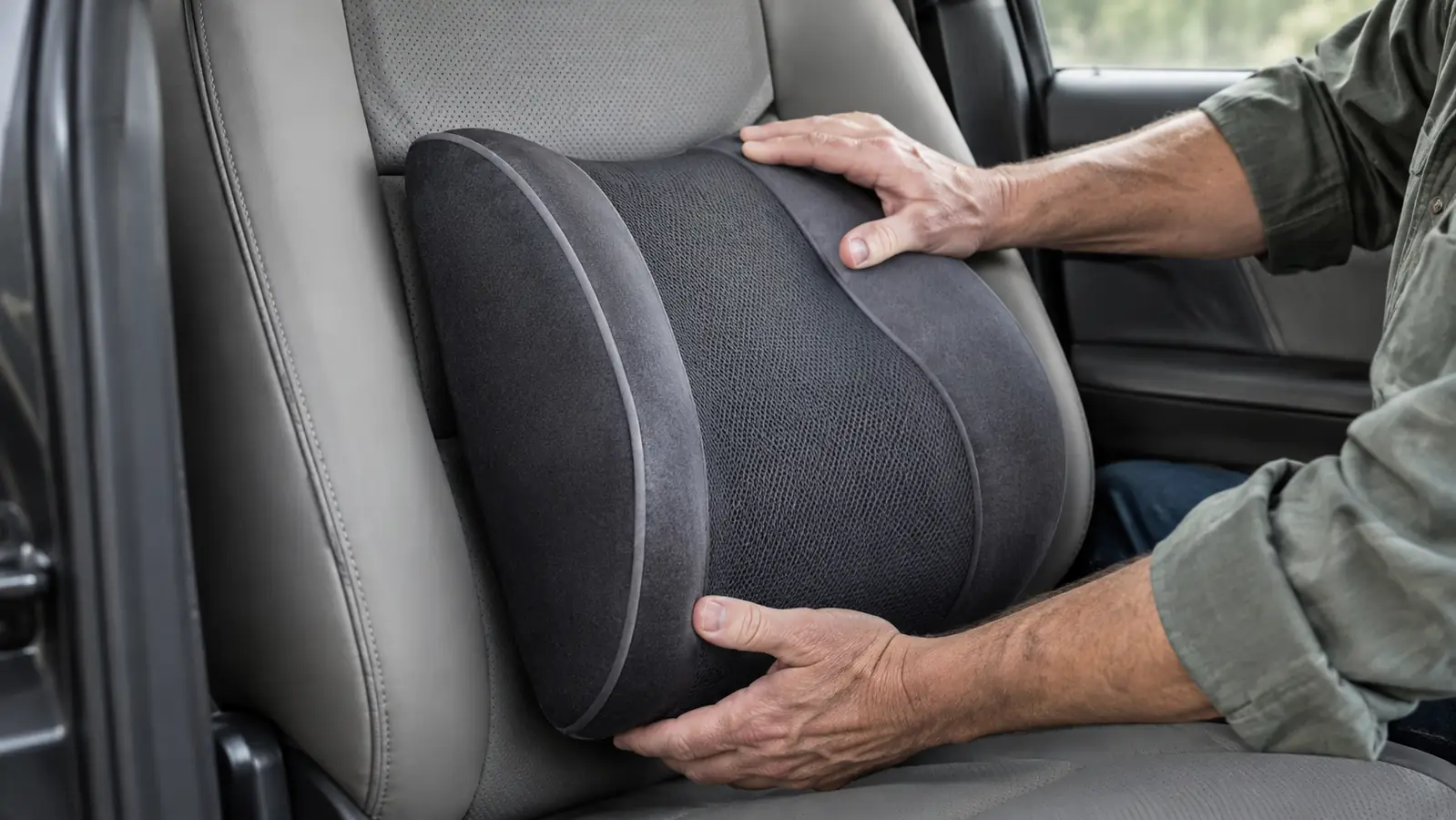
The Everlasting Comfort pillow has a contoured face, which means it is not a flat slab. The thicker part is meant to sit in the small of your back, right at the natural inward curve of your spine. Sit in the seat, then tuck the pillow behind you so the raised center of the contour lines up with that curve. For me, that puts the bottom edge of the pillow just above the seat cushion, roughly at the top of my hip bones.
This is the placement that feels wrong for the first ten minutes if you have been slouching for years, because it puts your pelvis in a more neutral position than you are used to. That is not a sign the pillow is in the wrong spot. It is a sign your lower back is finally being held where it should be. Give it a few minutes before you start nudging the pillow around. I learned this the hard way on a drive last October, when I moved the pillow four times in the first half hour and then realized the original spot had been right all along.
If the pillow sits too high, it pushes into your shoulder blades and you will feel it the whole drive. If it sits too low, it slides onto the seat cushion and does nothing. The right height is the one where you feel supported, not poked.
Step 3: Use the strap so it does not wander
The Everlasting Comfort pillow comes with an adjustable strap that loops around the headrest posts or over the top of the seat. On my CR-V, the headrest posts are the easiest anchor. I slip the strap over both posts, then tighten it until the pillow sits snug against the seat back. When it is adjusted right, the pillow stays put even when I get out of the car and get back in.
This matters more than it sounds like it should. A pillow that slides down two inches every time you brake is a pillow you will eventually stop using. The strap is the difference between a pillow that is part of the seat and a pillow that is a loose object you are constantly wrestling with. On the first trip I took without bothering to strap it, I reached for it at every red light on High Street, and by the time I got to the highway it was wedged against the door. That was a Tuesday in September, and I remember it because I pulled into the rest stop near Wilmington with the pillow in my lap and my lower back already complaining. I strapped it down in the parking lot, and the drive home that evening was the first one all week without the ache. It took me less than a minute to fix, which made the whole morning feel silly in retrospect.
If your car's headrest posts are fixed or shaped differently, the strap also works over the top of the seat back. It does not have to be pretty. It just has to hold.

Step 4: Sit back and let the pillow do the work
Once the pillow is placed and strapped, sit back normally and let your back rest against it. You are not trying to hold a military posture. You are letting the pillow fill the gap between your lower back and the seat so your spine stays in its natural curve without effort. Your shoulders should be able to relax, your head should sit over your shoulders instead of in front of them, and your hands should reach the wheel without you leaning forward.
The first time I did this, I kept waiting for the pillow to feel like something. It did not. It just felt like my back was where it was supposed to be, which is the whole point. A good lumbar setup is not a massage. It is the absence of the nagging ache that used to show up around mile forty. On a drive to Cincinnati last month, I noticed I had not thought about my back at all until I pulled into the driveway, and that was the first time that had ever happened. I clocked the change on the odometer the way I do everything these days: the ache used to start right around the Jeffersonville exit, mile forty-two on my usual route. On that same drive, I got all the way to the Kings Island exit, mile ninety-one, before I realized my back had been quiet the whole trip. That is a forty-nine mile difference, and it did not come from willpower.
If you feel like you are being pushed too far forward, the pillow is probably too thick for your seat or placed too high. Try shifting it down an inch before you give up on it. If your lower back still feels unsupported, the seat itself may be the problem, and that is worth checking with a professional who deals with vehicle seating.
Step 5: Adjust for the passenger seat, the office chair, and the couch
Once the pillow is set up in the driver's seat, you will notice the same hollow in every other seat you use. The Everlasting Comfort pillow is marketed for office chairs, gaming chairs, and couches as well as cars, and it genuinely does move between them. I keep a second one at my desk at work, where I spend three days a week at a front desk, and I have moved the car pillow to the passenger seat on longer trips with Dave so he can use it too.
The setup is the same everywhere. Sit in the seat, tuck the pillow behind your lower back, and strap it if the chair has a place for the strap. On an office chair with a mesh back, the strap can loop around the backrest. On a couch, there is usually nothing to strap to, so I wedge the pillow between my lower back and the cushion and accept that I will have to reposition it when I get up. The couch version is the one I use in my recliner at night, and I have learned to shove it down an inch when I start to slouch. At work, I use the pillow on a chair with arms that I had already been propping a folded sweatshirt against for a year. The sweatshirt worked about as well as you would expect, which is to say it bunched up by ten in the morning. The pillow has a firmer shape that does not bunch, and I stopped reaching behind me to fix it after the first week.
The couch is also where I have to be honest about my own habits. I slouch in my recliner at night and I know it. The pillow helps when I remember to use it, but it does not fix a habit I have spent decades building. It is a tool, not a cure, and I would rather say that plainly than oversell it.
What Else Helps
A lumbar pillow will carry a lot of the load, but a few other small habits made the biggest difference for me on long drives. I set the cruise control when I can, because it lets me stop gripping the wheel and relax my shoulders. I take a short break at the halfway point on the drive to Cincinnati, even if it is just pulling into a rest stop, standing up, and walking for five minutes. I also keep my phone in the center console instead of my pocket, so I am not leaning to one side the whole way.
If you have real back pain, not just the everyday stiffness I deal with, please check with a doctor or physical therapist. I am a former dental hygienist who spent twenty-six years leaning over patients, not a medical professional. What works for me may not be right for your back, and a professional can tell you the difference.
The pillow is a tool, not a cure. It fills the hollow in the seat so your spine sits the way it should without you having to think about it every mile.
Set yours up before the next long drive
The Everlasting Comfort Lumbar Support Pillow is the one I keep in my car, and the same setup steps work in an office chair or on the couch. It takes about five minutes to get it right the first time, and after that it is just part of the seat.
Amazon Check Today's Price on Amazon →