

I sat down to pay bills one night last fall and realized I'd been leaning into the same kitchen chair for an hour with my chin out like a turtle. That's when I ordered the Everlasting Comfort lumbar pillow, mostly out of pure frustration. I'm Marla, I'm 54, and I spent 26 years as a dental hygienist bent over patients, so my rounded shoulders and forward head are not a mystery. I've now used this pillow almost every workday at my front desk, on my laptop at home, and on the two-hour drive to my daughter's place in Cincinnati. This is what months of real use actually looks like.
A quick note before I go on: I'm not a doctor or a physical therapist, and I'm not going to promise you this pillow fixes your back. For real pain, check with a professional. What I can tell you is exactly how this thing behaved after months of daily use, what annoyed me, and who I think should skip it.
The Quick Verdict
A genuinely comfortable memory foam lumbar pillow that holds its shape and stays put, but only if you match it to your chair and your height.
Amazon Check Today's Price →Tired of slouching by 2 PM?
The Everlasting Comfort lumbar pillow is the one I reach for every workday. It gives my lower back something to lean into instead of letting the chair slump me forward.
Amazon Check Today's Price on Amazon →How I've Used It
My setup is not fancy. At home I have a small spare-bedroom desk with a laptop where I pay bills and write, and the chair is a basic office chair with almost no lumbar curve. At work I sit at a front desk three days a week, also in a standard office chair. In the car, I drive a 2016 Honda CR-V, and on the trips to see my daughter I'm in the driver's seat for about two hours each way.
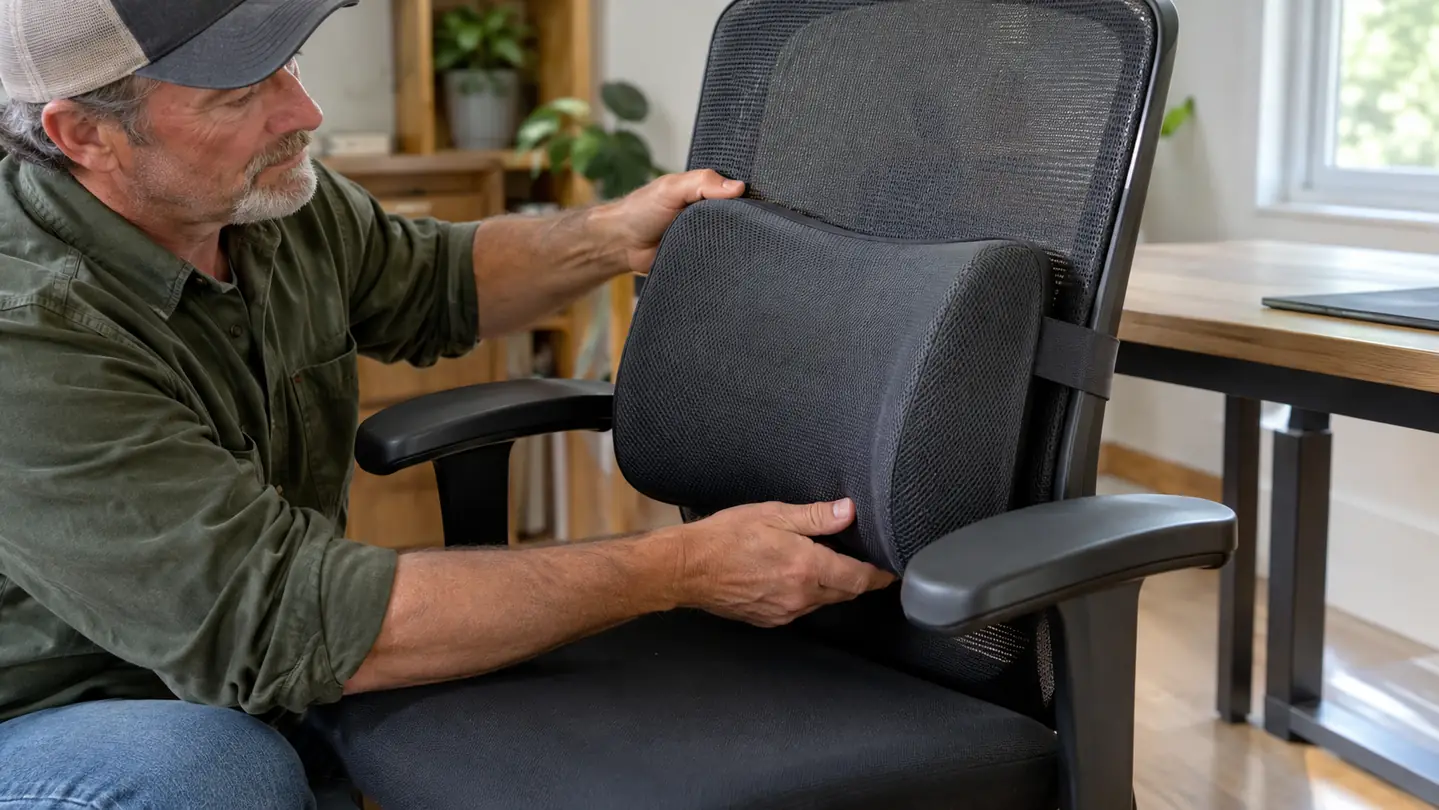
The pillow came with two straps that wrap around the chair back, which turned out to be the difference between a pillow that stays put and one that slides down behind you by lunch. I used it at the desk for about three weeks before I tried it in the car, and I've rotated it between the two ever since. I also keep a second one in the recliner at night, which I admit I slouch in, and it helps there too, though that's not what I bought it for.
I'll give you one concrete day. A Tuesday in late January, I was at the front desk from nine to three with a pile of insurance paperwork, the kind of day that used to leave a knot between my shoulder blades by one o'clock. I had the pillow positioned with the wider part at the bottom of the chair back, and I got through the whole afternoon without once catching myself hunched over the counter. That was the day I stopped treating it as a maybe and started treating it as part of my setup.
One honest note: I did not use it every single day for six straight months. I used it most workdays, most drives, and most evenings in the recliner. That's the real pattern for most people, and it's still plenty of time to find out what holds up and what doesn't. The pillow has been through an Ohio winter, a spring of pollen, and the start of summer humidity, and it has come through all of it without losing its shape or starting to smell, which I can't say for every foam product I've owned.
What the Memory Foam Actually Feels Like
The Everlasting Comfort pillow is made of memory foam with a contoured shape that curves to the small of your back. The first thing I noticed is that it's firmer than it looks in photos. That's a good thing for support, but it means the first two or three days feel a little odd if you're used to soft chair cushions. By the end of the first week, I stopped noticing it was there, which is exactly what you want from a support pillow.
The cover is a soft, breathable mesh that I can honestly say has not gotten gross after months of use. I live in Ohio, where summers get sticky, and I was worried about a foam pillow turning into a sweat sponge. The mesh lets air move, and the cover zips off for washing. I've washed mine twice, and it came out fine both times. That matters more than you'd think, because a pillow you can't wash is a pillow you stop using.
Before this one, I tried a cheaper foam roller-style back support that I bought on a whim. It was basically a firm cylinder on an elastic strap, and it did two things badly: it rolled out from behind me when I leaned forward, and after about a month the foam had a permanent flat spot where my back pressed. I mention it because it's the difference you feel immediately. The Everlasting Comfort pillow doesn't roll, because the straps hold it, and it doesn't flatten, because the memory foam is dense enough to spring back. Those two things are the entire reason I kept using it past the first week.
The foam itself has held its shape. After months of being compressed during the workday and then again in the car, it still springs back. I was half expecting a permanent dent in the middle, the way cheap foam cushions get, and there isn't one. I can't promise yours will be identical, foam varies, but mine has been remarkably consistent. The second wash was in June, after a stretch of ninety-degree days, and the cover came out of the dryer looking like new. The foam itself I've never washed, and I wouldn't, but a damp cloth and an air dry have been enough.
The Fit Question Nobody Talks About
Here's the thing I wish someone had told me before I bought it: the pillow works brilliantly in some chairs and barely at all in others. It needs a chair back that's tall enough to hold it in place, and it needs to sit at the right height for your body. On my home office chair, it's excellent. On a low-backed dining chair, it slides up and I end up pushing it back down every few minutes.
Let me give you the exact measurements, because that's the kind of thing I wanted before I bought it. The pillow is roughly sixteen inches wide and about eleven inches tall at its tallest point, with a contour that's deeper at the bottom. On my home office chair, which has a back about twenty-one inches tall, it sits perfectly, with the bottom edge resting right on the seat. On the kitchen chairs, the backs are only about fourteen inches tall, and the pillow's top edge sticks up past the chair back, which is why it tips forward and slides. Same pillow, same day, two completely different results.
I'm 5'6", and I found the sweet spot is with the pillow's wider part at the bottom, right at the curve of my lower back. My husband Dave, who is taller and has his own lower-back complaints, tried it once and said it sat too high for him. That's not a defect, it's a fit thing, but it means this pillow is not one-size-fits-all the way the marketing makes it sound. If you're very tall or very short, you may need to experiment with placement or look for a pillow with more height adjustment.
Dave's try was actually instructive. He's about six inches taller than me, and the curve of the pillow hit him right at the top of his hips instead of the small of his back. He spent five minutes trying to wedge it higher, gave up, and went back to the rolled-up towel he's used for years. That's not a knock on the pillow. It's a reminder that lumbar support is a fit thing, like a pair of shoes, and you can't know if it fits until you sit in it.
How It Did in the Car
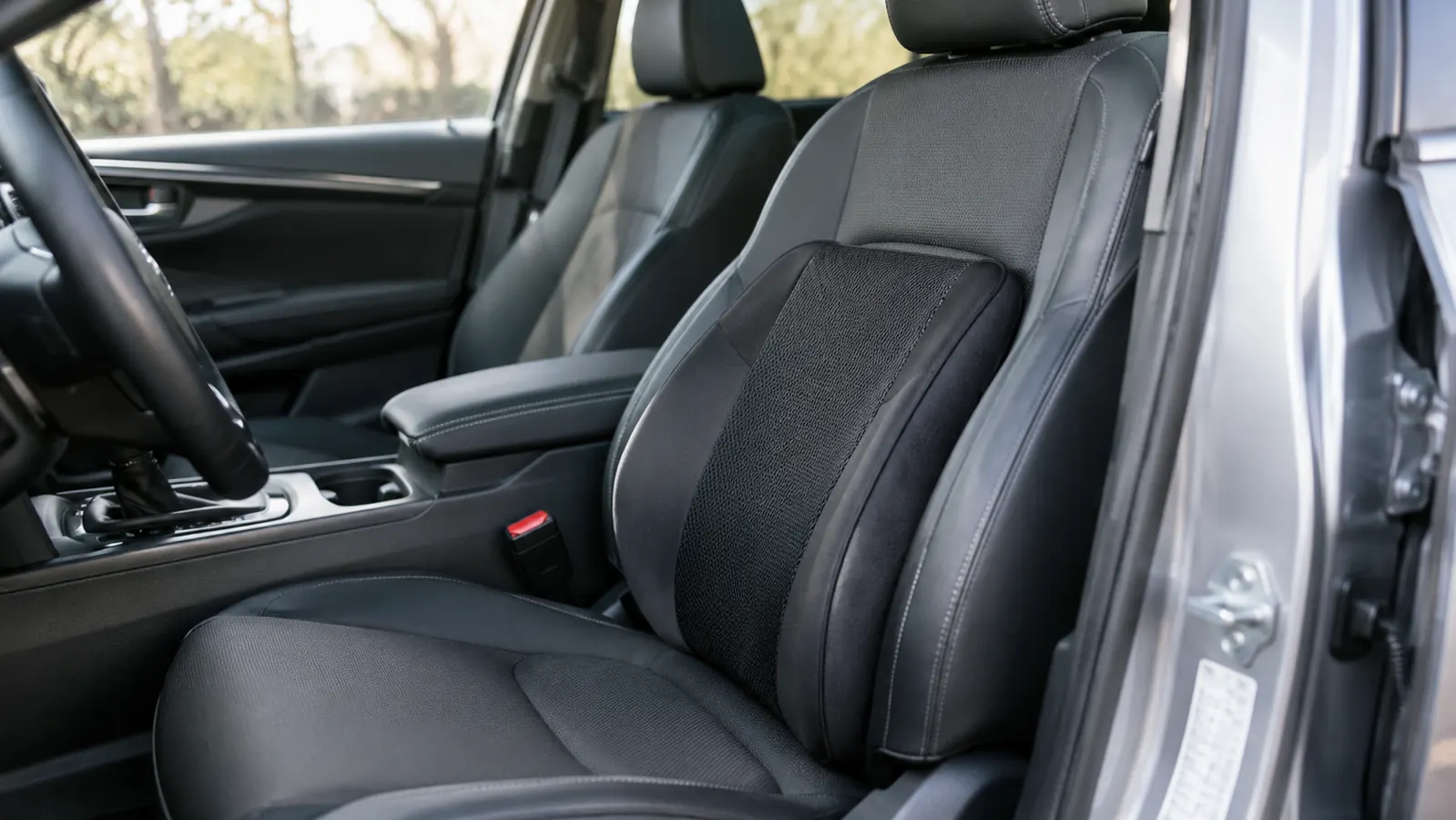
The car is where this pillow surprised me. I expected it to be a desk-only tool, but on the two-hour drive to Cincinnati, it made a real difference in how my neck and upper back felt when I arrived. The straps that hold it to a chair back also work on a car seat, and it stayed put through the whole drive, no constant readjusting.
My specific problem on long drives is neck stiffness from holding my head forward. The lumbar pillow doesn't fix that directly, but here's what happens: when my lower back has support, my whole spine stacks better, and my head sits more over my shoulders. I arrived noticeably less stiff than I usually do. I've now done that drive four times with the pillow, and the result has been consistent, not a fluke.
The most recent drive was in early July, a Friday afternoon with construction on 71 that turned a two-hour trip into nearly three. By the time I pulled into my daughter's driveway, my shoulders were tired from gripping the wheel in stop-and-go traffic, but my lower back felt fine and my neck wasn't stiff the way it usually is after that kind of day. My daughter even commented that I got out of the car without the usual wincing and stretching routine.
One thing I figured out on that drive: the pillow works better in the car when I angle it slightly, with the bottom edge tucked against the seat back and the top leaning forward just a touch. Straight up and down, it pushed me too far forward toward the wheel. That little angle adjustment took about thirty seconds and made the difference between support and pressure.
One small complaint: in the car, the pillow takes up a little room on the seat, and if you're sharing the car with someone, it's one more thing to move when they get in. It's not a big deal, but it's the kind of small friction you only notice after months of use.
What Wore Out and What Didn't
After months of use, the cover still looks good, the zipper still works, and the foam still holds its shape. The straps have stretched a little, which means I have to cinch them slightly tighter than I did at first, but they still do the job. I consider that normal wear, not a defect.
What did not hold up as well: the mesh cover picks up lint and pet hair like crazy. We don't have pets, but if you do, you will be using a lint roller on this pillow regularly. It's a minor thing, and it washes off, but it's worth knowing before you buy.
The other thing I noticed is that the pillow's effectiveness depends on the chair more than the pillow. In my kitchen chair, it's nearly useless. In my office chair, it's great. If you're buying this for a specific chair, make sure that chair has a back that's tall enough to support the pillow. That's the single biggest factor in whether you'll actually use it.
The one thing I'd watch is the strap stitching. The straps are sewn to a fabric tab that tucks between the pillow and the chair back, and on mine the stitching on one tab has started to fray just a little at the edge. It's cosmetic, not structural, and it hasn't affected how the pillow holds, but after six months I can see it's the first thing that will eventually need attention. If I get another year out of it before that becomes a real problem, I'll consider that a fair run.
What I Liked
- Genuine memory foam that holds its shape after months of daily use
- Straps keep it in place on both office chairs and car seats
- Breathable mesh cover that zips off and washes clean
- Makes a real difference on long drives, not just at a desk
- Firm enough to actually support, not just cushion
Where It Falls Short
- Fit depends heavily on your chair; low-backed chairs make it slide
- Mesh cover collects lint and pet hair and needs regular cleaning
- Height placement takes trial and error, especially for taller or shorter people
- Takes up noticeable room on a car seat when you're not using it
The pillow's effectiveness depends on the chair more than the pillow. In my kitchen chair, it's nearly useless. In my office chair, it's great.
Who This Is For
This pillow is for anyone who spends hours in a chair or a car and wants something to lean into, not a cure for back pain. It's for people who know they slouch and want a physical reminder to sit better. It's for desk workers who don't have a fancy ergonomic chair and want to add support to the one they have. It's for drivers who arrive at their destination with a stiff neck, the way I used to.
It's also for people who want something they can move around. I use mine at work, at home, and in the car, and it takes about ten seconds to move it from one place to another. If you have one main chair and one main car, this is a simple, low-cost way to add support to both.
Who Should Skip It
Skip it if you have a low-backed chair, a bucket seat with aggressive bolsters, or a seat that's already deeply contoured. The pillow needs a flat-ish surface to work against, and if it doesn't have one, you'll spend more time adjusting it than benefiting from it.
Skip it if you're looking for a cure for actual back pain. I said this at the start and I'll say it again: I'm not a doctor, and a foam pillow is not treatment. If you have real pain, spend your money on a professional opinion first. This pillow is a comfort tool, a good one, but it's not a substitute for medical advice.
And skip it if you're very tall or very short and don't want to fiddle with placement. The Everlasting Comfort pillow works best for average-height people like me. If you're outside that range, you may find yourself constantly adjusting it, and that friction will eventually make you stop using it altogether.
The lumbar pillow I keep coming back to
After months of daily use, the Everlasting Comfort lumbar pillow is still the first thing I reach for when I sit down to work or drive. If your chair could use more support, it's worth a look.
Amazon Check Today's Price on Amazon →