

If you sit at a desk for a living, you already know the feeling: by 10 AM your lower back has gone hollow, you've caught yourself slouching twice, and the small of your back is pressing against nothing. I spent 26 years leaning over patients as a dental hygienist, and now that I work a front desk three days a week, I've collected a graveyard of things that were supposed to fix that feeling. First I rolled up a bath towel and tucked it behind my back; it worked for about an hour before it crumpled into a lump I had to fish out and re-roll. Then a cheap foam wedge from the drugstore, which was too firm and pushed me forward instead of holding me up. Then a friend's fancy chair with built-in lumbar support, which was great until I had to give the chair back. I even tried one of those posture shirts, and all it did was make me aware of how often I slouch, which is apparently constantly. So when people who sit as much as I do ask whether they should buy the Everlasting Comfort Lumbar Pillow or the Samsonite lumbar pillow, they're really asking whether any of these things actually works. I used both for three weeks on the exact same chair, kept a little notebook in the desk drawer to track how often each one needed fixing, and here's the honest answer.
The short version: the Everlasting Comfort Lumbar Pillow is the one I'd buy again, because it stays put, follows your back when you lean forward, and adjusts to fit a 5'4" frame like mine or a 6'2" frame like Dave's without any fiddling. The Samsonite lumbar pillow is a better travel companion and a better fit for a rigid chair with a flat back, but on a normal desk chair it slid down by mid-morning and I had to keep re-tucking it. In my notebook, the Everlasting Comfort pillow needed two adjustments in a full eight-hour day, both of them after I'd gotten up to stretch. The Samsonite pillow needed six on a good day and seven on a bad one. That one difference decides most desk-day arguments, because a pillow you have to fix stops being support and starts being a chore. I want to be honest about what this test did and didn't cover. I didn't measure pressure or film myself sitting; I just kept a notebook and paid attention to what my body did at the end of the day. That's the test most shoppers can actually repeat, and I think it's the one that matters.
| Everlasting Comfort Lumbar Pillow | Samsonite Lumbar Pillow | |
|---|---|---|
| Back support | Memory foam that contours to your lower back and keeps contact when you lean forward | Firmer foam that holds its shape but leaves a small gap when you shift |
| Stays in place | Two straps anchor it to the chair; I adjusted it once or twice a day | Slid down the backrest by late morning; I re-tucked it four or five times a day |
| Fit range | Works for short and tall sitters; the strap placement lets you set the height | Best for a mid-height backrest; it sat too high on my chair |
| Portability | Strap it to a chair and leave it there; fine for one spot | Smaller and lighter, easy to toss in a bag for a plane or a rental car |
| Materials | Breathable cover with a zipper, easy to wash | Smooth cover that wipes clean but doesn't breathe as much |
| Best for | A desk chair you sit in for hours every day | Travel, short stints, and chairs with a flat, firm back |
Where Everlasting Comfort Wins
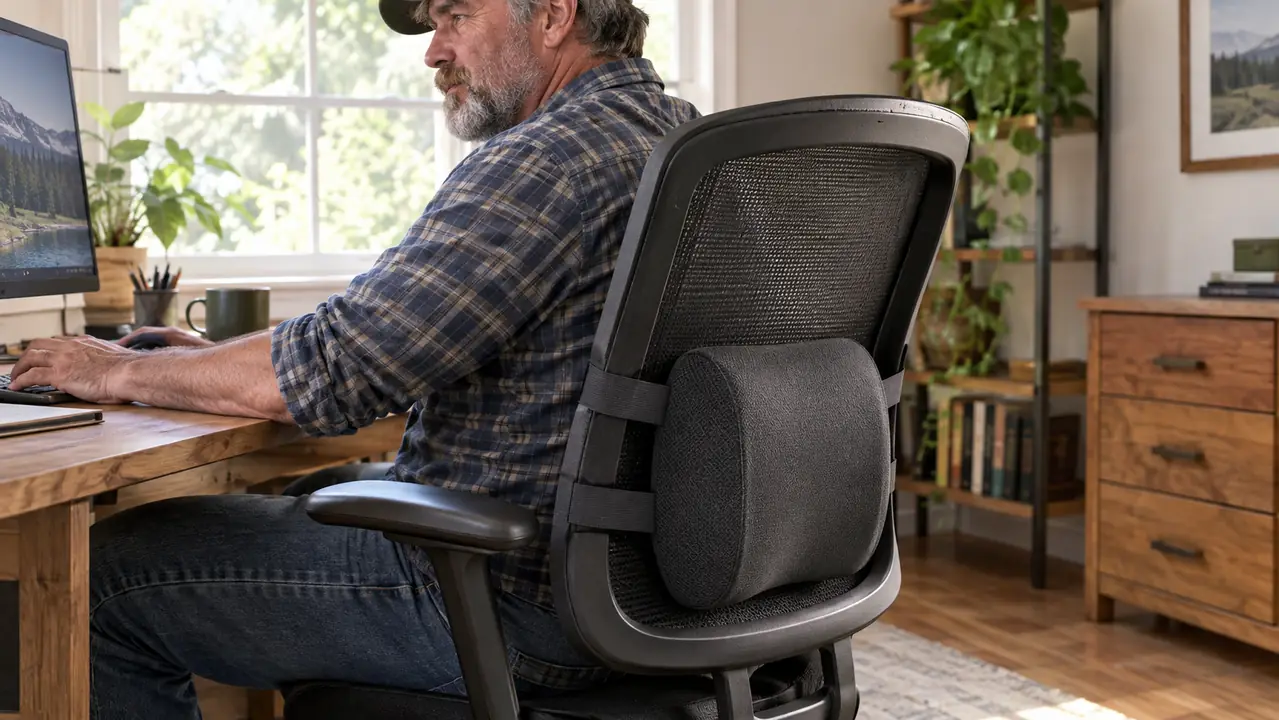
The biggest difference showed up on day one, a Tuesday, and it showed up before lunch. The Everlasting Comfort Lumbar Pillow has a curved memory foam shape that cups your lower back, and the two straps hold it at whatever height you set. On my chair, a plain mesh-back office chair I've had for six years, I set it so the thickest part of the curve sat right at my belt line. It took maybe twenty seconds, and I did it without looking at any instructions because there weren't any to speak of, just two straps and a buckle. I should say the first time I strapped it on, I put it too high and spent an hour with the curve poking me between the ribs. The fix was simple: loosen the straps, drop it two inches, tighten again. That's the whole learning curve, and it took less time than finding my reading glasses. The Samsonite pillow never gave me that option, because it didn't have straps at all. When I leaned forward to type, the pillow followed me a little instead of dropping away, and when I sat back, there it was again. That continuous contact is what keeps me from slouching, and it's the thing I noticed most after a full day. By Wednesday I stopped thinking about the pillow entirely, which is the best thing I can say about any piece of back support. The cover has a zipper, so I took it off and washed it after the first week, and it went back on without a fight. That matters more than it sounds like, because the cheap wedge from the drugstore had a cover that was sewn shut and I could never clean it. I also noticed the foam didn't go flat where I sat, the way the wedge did. After eight hours it still had its shape, and the next morning it looked the same as the day I opened the box.
It also handles different bodies without any adjustment. Dave, my husband, is a retired mail carrier who is a foot taller than me and has his own lower-back complaints from thirty years of hauling mail bags. One Saturday afternoon I asked him to sit in the same chair and watch a ballgame, just to see if the pillow would shift under a different frame. He didn't need to move it once. He got up at the end of the third inning and said, 'That's the first chair pillow that hasn't dug into me,' which from Dave is practically a speech. That's the kind of range you don't get from a one-size foam block. The strap placement is what makes it work: you can set the pillow high for a long torso or low for a short one, and the memory foam softens where it needs to and firms up where it doesn't. One thing I want to be clear about: this pillow is not soft. It's firm, and that's what I wanted. The first foam wedge I tried was soft enough to squish flat by noon, which is why I stopped bothering with it. This one gives you something to push against. I also used it in the recliner one night, the one I admit I slouch in, and it helped there too, though it's clearly made for a chair with a backrest. On the couch it slid around, so I wouldn't call it a couch pillow, but that's not what it's for. After three weeks, I'd call the Everlasting Comfort pillow the better buy for anyone whose chair is their home base for eight hours.
Where Samsonite Wins
I'm not going to pretend the Samsonite lumbar pillow didn't have its moments, because it did. It's smaller, lighter, and firmer, which makes it genuinely better when you're moving around. The Friday after my first week of testing, I drove my 2016 Honda CR-V to Cincinnati to visit my daughter, about two hours each way, and I brought the Samsonite pillow along. It was the better car pillow by a wide margin. It sat against the seat without sliding, and the firmer foam gave my lower back something solid to press into on the long stretch of highway where the seat starts to feel like a park bench. My neck still got stiff, because that's a two-hour drive no matter what, but my lower back wasn't the thing complaining when I got out of the car. I also threw it in a tote bag for a weekend trip and it weighed almost nothing, which is more than I can say for the Everlasting Comfort pillow, which is built for a chair and knows it. If you want a pillow to keep in a bag for flights, trains, or the occasional rental car, Samsonite is the one to grab.
It also wins on chairs with a flat, rigid back. My daughter has a cheap dining chair in her apartment, and the Samsonite pillow sat on it like it was made for it, no straps needed. The problem is that most desk chairs aren't flat. They curve, they tilt, they have a gap between the backrest and the seat, and that's where the Samsonite pillow lost me. On my usual chair it slid down by late morning, and by 2 PM I was re-tucking it every time I got up. My notebook says I adjusted it six times on a Tuesday and seven on a Thursday, and on Thursday one of those adjustments was me giving up and just working without it for an hour. I kept waiting for it to break in, but after three weeks the foam was exactly as firm as the first day, which is good for a car seat and wrong for a desk chair. It also sat too high on my backrest, so the thick part of the curve landed between my shoulder blades instead of at my belt line, and no amount of shifting fixed that because there was nothing holding it in place. To be fair, I think part of the sliding is the shape of my chair. The backrest tilts back slightly, and anything without a strap is going to want to settle at the bottom of that tilt. The Samsonite pillow is a good shape for a chair that doesn't move; my chair moves, and so did the pillow. A pillow that needs constant attention isn't supporting you; it's just another task.
The pillow that actually stays put through a full desk day
The Everlasting Comfort Lumbar Pillow is the one I kept on my chair after three weeks of swapping. It contours to your lower back, straps on at the right height, and doesn't slide down by lunch. Check today's price on Amazon to see if it fits your chair the way it fit mine.
Amazon Check Today's Price on Amazon →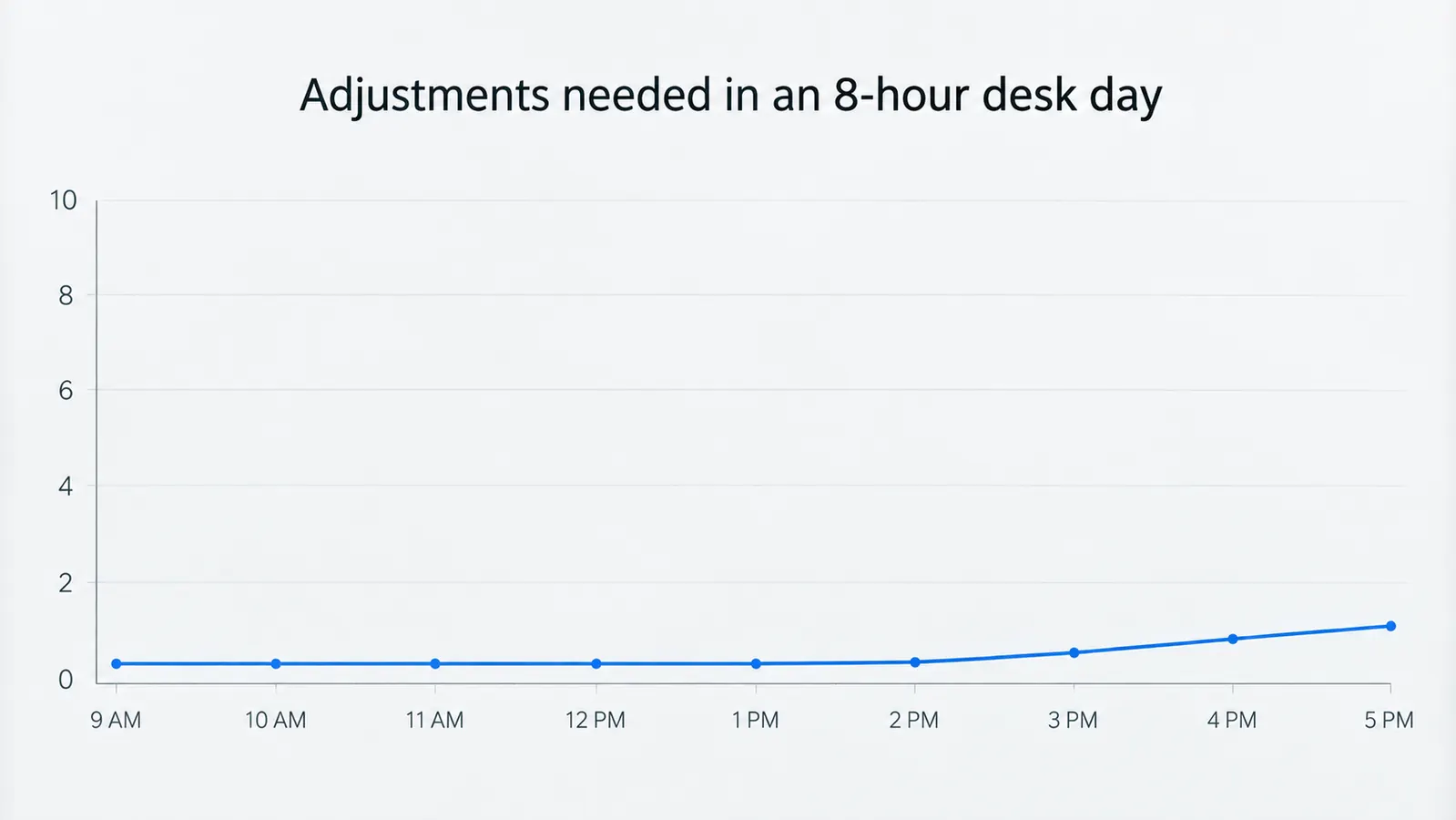
Who Should Buy Which
Buy the Everlasting Comfort Lumbar Pillow if you sit at a desk for most of the day, if your chair has a curved or padded backrest, or if you want something that keeps contact with your back when you lean forward. That's the person this pillow was made for. It's also the better choice if you're buying for a shared chair, because it adjusts in seconds and works for a wide range of heights. Dave and I swapped that chair all weekend and neither of us touched the straps after the first setting. If you're the kind of person who forgets to sit up straight until something reminds you, the Everlasting Comfort pillow is that reminder, and it doesn't need you to remember to fix it. It's not a cure for a bad chair or a long day, and I don't want to oversell it, but it does the one job a desk pillow is supposed to do, which is stay exactly where you put it. Buy the Samsonite lumbar pillow if you travel often, if you want something small enough to toss in a bag, or if your main chair has a flat, firm backrest. It's a good pillow. It's just not the right pillow for a standard desk day, and that's the test most people are actually shopping for. If you're still torn, ask yourself one question: where will you use it most? If the answer is 'in front of a computer,' go with Everlasting Comfort. If the answer is 'in a car, on a plane, or in a folding chair at my kid's game,' the Samsonite pillow will serve you better and take up less room doing it. I kept mine in the house for the drives to Cincinnati, and I don't regret that for a second. Both of them are better than the rolled-up towel, and that's the bar most of us are actually trying to clear. And if you're still not sure, buy the one that matches the place you'll actually sit. I know that sounds obvious, but most of the people who ask me this question are buying for a chair they hate, and no pillow fixes a chair you hate. If the chair is the problem, fix the chair first, then add the pillow.
Still deciding? Start with the one built for desk hours
After three weeks of swapping them on the same chair, the Everlasting Comfort Lumbar Pillow won my desk for good. It stays put, breathes, and fits both me and Dave without adjustment. See today's price on Amazon and decide for yourself.
Amazon Check Today's Price on Amazon →