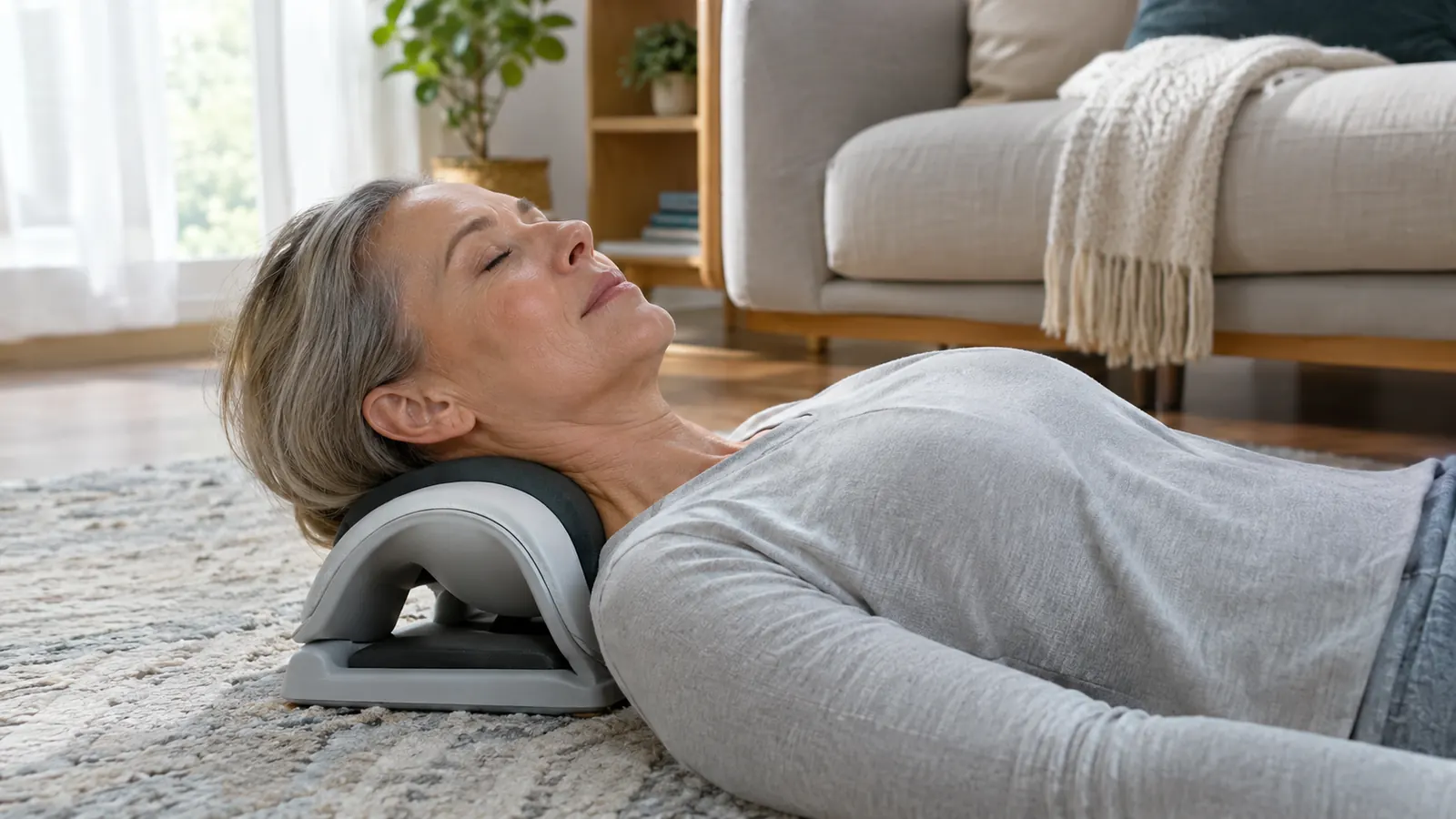
I bought the RESTCLOUD Neck and Shoulder Relaxer because I finally got tired of the knot between my shoulder blades. Twenty-six years of leaning over patients as a dental hygienist left me with rounded shoulders and a forward head, and by three in the afternoon I was rolling my neck like it owed me money. The product page says it relieves TMJ pain, aligns the cervical spine, and works as a chiropractic pillow. That is a lot of promises. I wanted to know which ones were true.
So I used it for six weeks, most nights for fifteen minutes before bed, and a few afternoons when my neck was especially cranky. I kept notes. I complained to my husband Dave about the smell. I almost returned it. And in the end I kept it, because it does something nothing else in my house does. Here is the honest review, including the parts the listing photos do not show you.
The Quick Verdict
The RESTCLOUD is a genuinely useful traction device that helped my forward head and neck stiffness, but the foam is firmer than advertised, the smell takes days to fade, and the curve may be too aggressive for true beginners. Buy it if you want a cheap, simple way to stretch your neck at home. Skip it if you have acute pain, a recent injury, or zero patience for setup quirks.
Amazon Check Today's Price →The neck stretcher that actually gets used
After six weeks, this is the device I keep reaching for when my neck is tight after a long day. It is not perfect, but it works, and it costs a fraction of a massage.
Amazon Check Today's Price on Amazon →What Nobody Tells You Before You Buy It
The listing makes the RESTCLOUD look like a firm, supportive pillow you rest your neck on. That is half true. The foam is dense and it does support you, but it is a traction device, which means it is designed to stretch your neck, not cradle it. The first time I lay down on it, I felt a strong pull at the base of my skull. Not pain, exactly, but a definite stretch. If you have never used cervical traction before, that sensation is surprising. I kept expecting it to feel like the cervical pillow at my chiropractor's office, which is soft and almost plush. This is not that. The foam does not give much, and the curve does the work.
The other thing nobody tells you is the smell. Out of the box, this thing reeks. It is a strong chemical odor that lingered in my spare bedroom for about four days. I washed the removable cover twice and left the foam on the porch for an afternoon. That helped. The worst moment was the second night. I walked into the spare bedroom and the smell hit me before I flipped on the light. Dave came in to say goodnight, wrinkled his nose, and left without saying a word, which for Dave is a full review. Leaving the foam on the back porch overnight helped more than the washing did. The cover is machine washable, so that part was easy, but the foam itself is what carries the odor. The odor is strongest in the first two days. By the end of the first week I could only smell it if I put my nose right against the foam. If you are sensitive to smells, order it a week before you plan to use it.
And then there is the size. The RESTCLOUD is smaller than it looks in the photos. It is about the size of a thick travel pillow, not a full cervical pillow, and it weighs just over a pound. That is fine for the floor, but if you were hoping to use it in bed or on the couch, it slides around. I used it on the floor in front of the recliner, which worked well once I got used to the setup. The cover zips off for washing, and the whole thing fits back in the box it came in, which is more than I can say for most things I order.
The biggest surprise was how aggressive the curve felt at first. The listing photo shows a woman lying on the device with her eyes closed and a peaceful expression. My first attempt involved a lot of repositioning. The device wants to sit in one particular spot, right at the base of the skull, and until you find that spot it feels wrong. Once I found it, the stretch made sense. But finding it took three tries, and I almost put the thing back in the box on night one. The second night was better, and by the third night I stopped thinking about the curve entirely. I have read reviews complaining that the device is too small for taller people. I cannot speak to that from my own neck, but it is the most common complaint in the reviews, and it is worth knowing before you buy.
How I Used It and What I Felt
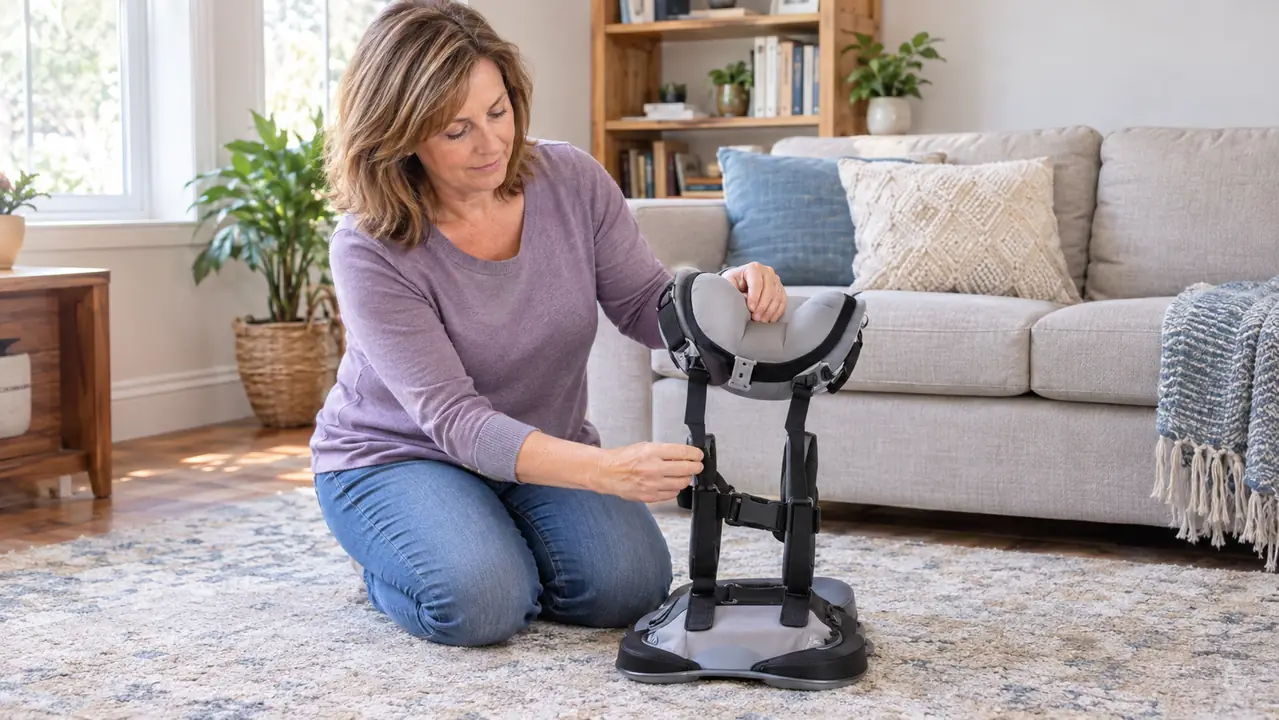
I used the RESTCLOUD the way the instructions suggest: lying on my back with the curve under my neck, knees bent, arms relaxed. The first week, I could only manage about five minutes. The stretch was intense, and my neck felt a little sore afterward, which I now understand is normal. By week two, I could do the full fifteen minutes without needing to stop. The instructions say to start with five to ten minutes and work up. I ignored that and tried ten minutes on night one, because I am impatient. That was a mistake. My neck was stiff the next morning in a way that felt different from my usual tightness, more like I had overdone it at the gym. I backed off to five minutes for the rest of that week and built up slowly. If you are the type to skip instructions, do not skip these.
My routine settled into something boring and reliable. Around nine forty-five, after Dave headed to bed, I would spread a folded blanket on the spare bedroom floor, lie down with the RESTCLOUD under my neck, and set the timer on my phone for fifteen minutes. I kept a book next to me for the first week, but I could not read and stretch at the same time, so I mostly stared at the ceiling and let my mind go blank. That turned out to be the part I liked. Fifteen minutes of not leaning forward is a long time.
The most noticeable change was in my posture, not my pain. After about three weeks, I caught myself standing taller at the front desk. My head was no longer jutting forward quite as much, and the tight spot between my shoulder blades appeared later in the day, or not at all. I cannot say the RESTCLOUD fixed my posture, because posture is about everything you do all day, not fifteen minutes on the floor. But it made me aware of my neck in a way I had not been in years. The real test came in early April, when I drove the two hours to see my daughter in Cincinnati. I usually arrive with a stiff neck from watching the highway and gripping the wheel. That trip, I did my fifteen minutes the night before and again the evening I got home. I will not pretend the drive was painless, but the stiffness was noticeably less, and I did not spend the next morning rolling my neck at the front desk. I also started doing a small thing during the day: when I caught my chin drifting toward the keyboard at the front desk, I would tuck it back and hold for a few seconds. The RESTCLOUD did not teach me that move, but lying on it every night made me notice when I was slumping. Awareness is half the battle, and the device gave me that.
What it did not do: it did not relieve my TMJ symptoms. I do not have severe TMJ, but I clench my jaw at night, and I was hoping the device would help. It did not. The RESTCLOUD stretches the neck, but it does not do anything direct for the jaw, and my clenching did not improve. I tried positioning it higher under my head, thinking that might change the angle for my jaw. It did not. I tried it in the evening instead of before bed. That did not change anything either. The device is built for the curve of the neck, and the jaw is simply not in its reach. I mention this because the product title lists TMJ relief first, and I would have bought it for that alone if I had not read the fine print. If TMJ relief is your main goal, this is probably not the device for you.
The Good, the Bad, and the Honest Middle
The good: the RESTCLOUD is simple, portable, and effective at stretching the neck. It is also cheap, which matters when you are not sure whether a device will work for you. The bad: the foam is firmer than I expected, the smell is real, and the curve is aggressive for beginners. The honest middle: it is not a cure-all, but it is a useful tool, and for the price, it is worth trying.
What I Liked
- Simple to use, no batteries, no setup
- Genuinely stretches the neck and relieves tension
- Removable, washable cover
- Cheap compared to massage or physical therapy
- Small and portable, easy to store
Where It Falls Short
- Strong chemical smell out of the box
- Firm foam, not plush like the photos suggest
- Curve may be too aggressive for true beginners
- Slides around on beds and couches
- Does nothing for TMJ despite the listing claims
After three weeks, I caught myself standing taller at the front desk. My head was no longer jutting forward quite as much, and the tight spot between my shoulder blades appeared later in the day, or not at all.
Who This Is For
The RESTCLOUD is for people who sit at a desk all day and come home with a tight neck, which describes most of the people I worked beside for twenty-six years. It is for people who have tried stretching on their own and want something that holds their neck in a better position for a few minutes, because I tried the stretching and it did not stick. It is for people who are curious about cervical traction but do not want to spend a lot of money to try it. And it is for people who, like me, spend their evenings in a recliner with their chin on their chest and wonder why their neck hurts in the morning. If that sounds like you, this device is worth a shot.

Who Should Skip It
Skip the RESTCLOUD if you have acute neck pain, a recent injury, or any diagnosed condition involving your cervical spine. I am not a doctor and I do not pretend to be one in this review, but I know that stretching something that is already hurt is a good way to make it worse. If you have real pain, check with a doctor or physical therapist before you put any kind of traction device on your neck. Skip it if you hate strong smells, because the foam odor is real and it does not fade in a day. And skip it if you want a soft, plush pillow to rest your head on, because this is not that. The RESTCLOUD is a tool, not a comfort object. It stretches, and the stretch is the point.
How It Compares to the Alternatives I Tried
Before I settled on the RESTCLOUD, I tried two other things: a rolled-up towel and an inflatable neck traction device. The towel was free and it worked okay, but it did not hold its shape and I had to adjust it constantly. The towel experiment lasted about a week. I folded a bath towel in half, rolled it as tight as I could, and taped the ends so it would not unroll. It worked for maybe four minutes. Then the roll loosened, the angle flattened, and I was lying on a lump instead of a stretch. I would get up, re-roll it, lie back down, and start over. By the end of the week I was spending more time fixing the towel than relaxing, and I gave up on it.
The inflatable device I tried belonged to a friend at the front desk. It came with a hand pump and a little release valve, and the idea was to pump it to the firmness you wanted. The problem was that my idea of the right firmness changed every night. I would lie down, decide it needed more air, get up, pump it, lie down again. The air also settled as it warmed up, so the device felt different ten minutes in than it did at the start. It was comfortable once I got it right, but the ritual was long enough that I skipped it more nights than I used it. The RESTCLOUD sits in the middle: easier than the towel, cheaper than the inflatable, and it works well enough that I actually use it.
I also considered one of the contoured cervical pillows that a coworker at the front desk swears by. She has used hers for two years and says she cannot sleep without it. What stopped me was the cost and the uncertainty. I had never tried cervical traction, I did not know if my neck would tolerate it, and I did not want to spend that kind of money to find out. The RESTCLOUD cost a fraction of that, which made it the low-risk way to answer the question. Six weeks later I have my answer: my neck likes traction, and I would spend more on a pillow now that I know it. The other thing I compared it to was a massage. A good massage loosens my neck for about a day and a half, and then the knot comes back. I cannot afford one every week. The RESTCLOUD is not a massage and it does not feel like one, but it is something I can do every night, and that consistency is what made the difference.
The Bottom Line
The RESTCLOUD Neck and Shoulder Relaxer is not the product the listing makes it out to be. It is firmer, smellier, and more aggressive than the photos suggest. But it is also genuinely useful, and after six weeks, it is the device I reach for when my neck is tight. If you go in with realistic expectations, it is a solid purchase. If you go in expecting it to fix everything, you will be disappointed. What I would tell a friend is this: buy it if you want a cheap, simple way to find out whether your neck likes traction. Use it on the floor, not the couch. Give the smell a week. And do not judge it by the first two nights, because the first two nights are the worst. I have kept mine on the floor of the spare bedroom, right next to the folded blanket, so it is part of the routine instead of a project. That is the real test of any health gadget, whether it survives the second week. The RESTCLOUD did, and six weeks later it is still there.
Still curious about the RESTCLOUD?
It is not perfect, but it helped my neck more than anything else I tried at home. See today's price and decide for yourself.
Amazon Check Today's Price on Amazon →