By mid-afternoon, I can find the spot without looking. It sits right between my shoulder blades, a knot that builds up over a day of leaning forward. Twenty-six years as a dental hygienist put it there, leaning over patients with my shoulders rolled in and my head reaching toward their mouths. These days I work a front desk three days a week, and the knot still shows up right on schedule. Some days it is just tight. Other days it feels like a golf ball that has taken up residence. It is the reason I started looking for something that worked longer than a doorway stretch.
I tried the usual things first. Doorframe stretches, a foam roller I kept meaning to use, a tennis ball wedged against the wall. They all helped for about ten minutes, and then the knot came back. What finally made a difference was a back stretcher, specifically the ChiFit Multi-Level Back Stretching Device. The difference is that it holds the stretch for you. You lie down on the arch, it does the work, and your muscles have nowhere to go but to let go. No counting, no pushing, no bouncing. You just lie there and let it happen. The whole thing takes less time than a coffee break. Here is the routine I have used for the last several weeks, step by step.
The Stretcher That Finally Got the Knot Out
The ChiFit Multi-Level Back Stretcher is the tool I reach for at the end of a desk day. It has adjustable levels, so you can start gentle and work up as your back loosens. Check today's price on Amazon to see the current options.
Amazon Check Today's Price on Amazon →How I Use the ChiFit Back Stretcher
Step 1: Put the Stretcher on the Floor, Not the Bed
The first thing I learned is that the surface matters more than you would think. A bed is too soft. The arch sinks into the mattress and you end up with a fraction of the stretch, plus a sore lower back from the odd angle. I learned this the hard way after one session on the guest bed. I use the living room floor with a yoga mat under me. A firm surface keeps the arch where it belongs and lets your back do the relaxing instead of the mattress.
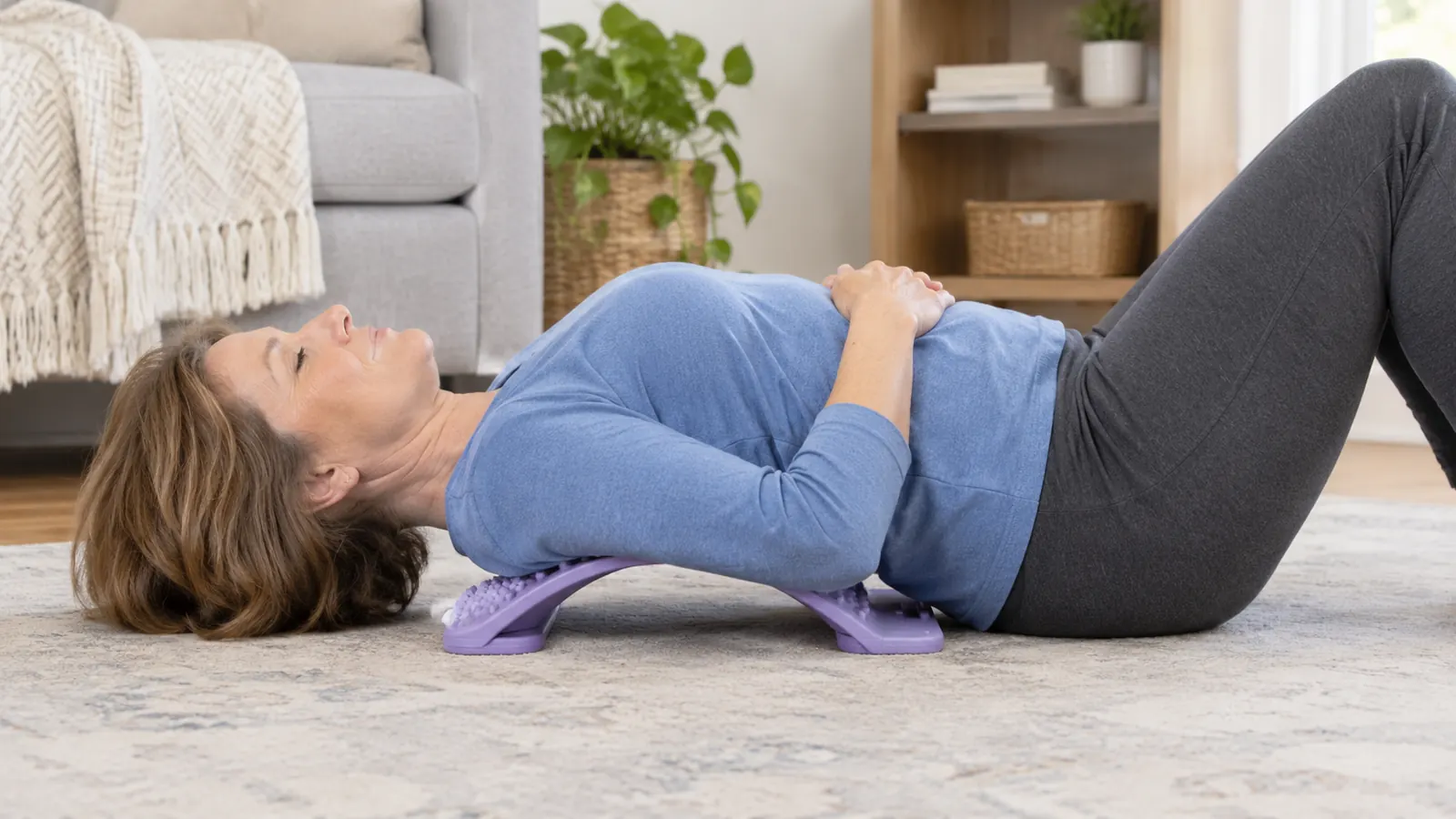
Set the ChiFit to its lowest level for the first few sessions. The device has multiple levels for a reason, and the gentlest one is the right place to start. Place it on the mat with the arch facing up, then sit down in front of it and lie back so the curve sits under your upper back, right beneath the tight spot between your shoulder blades. It should feel like pressure, not like a ledge.
If the arch lands under your lower back, you have scooting to do. Shift yourself up or down until you feel it pressing against the knot, not below it or above it. The first time I did this, I had to adjust twice before I found the spot. That is normal, and it is worth the extra ten seconds. Getting the position right is the difference between a good session and a wasted one. Once you feel it in the right place, you will know.
Step 2: Lower Yourself Down Slowly and Give Your Arms Somewhere to Go
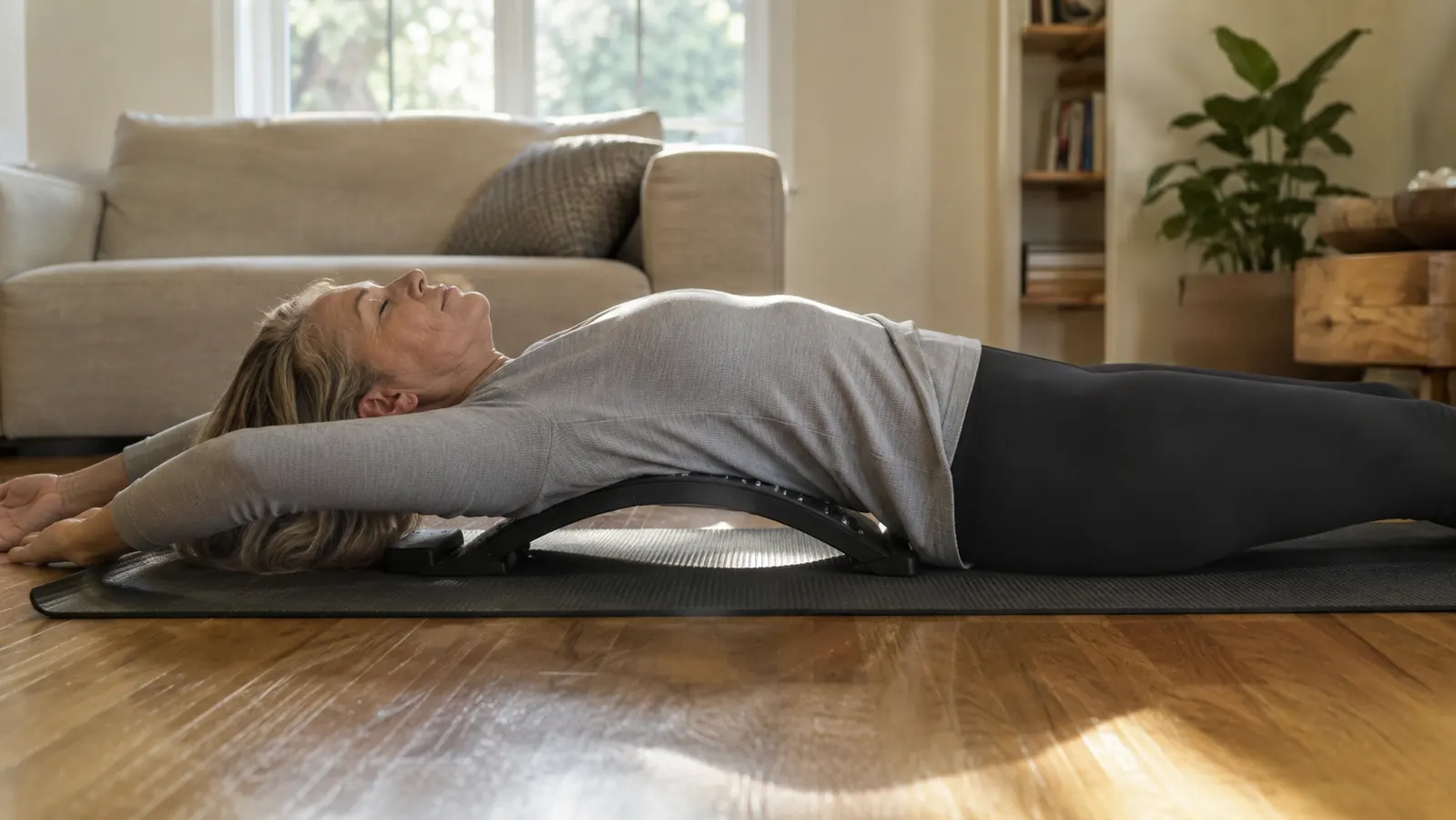
Once the arch is in the right place, lower yourself down slowly. Do not drop onto it. Let your head come down to the floor and let your neck relax. The stretch builds as you settle, so give it a few seconds before you decide whether the position is right. The first few seconds are the most intense, and they ease off as your muscles get the message. Your body will tell you if the position is right.
Arms matter more than I expected. When I first started, I kept my hands on my stomach, which helped but left my shoulders rolled forward. When I moved my arms overhead and let them rest on the floor, the stretch moved right into my chest and the front of my shoulders. That is where a lot of the desk tightness actually lives. If overhead bothers your shoulders, keep your hands on your belly. Both approaches work, and the one you can relax into is the right one for you.
Breathe slowly and evenly. The arch is doing the work, so you do not need to push anything. On the exhale, I can feel the muscles between my shoulder blades let go a little more. I have learned not to hold my breath, because holding it makes the whole thing feel like a chore instead of a rest. Slow breaths, soft shoulders, and let the arch earn its keep. Some evenings I close my eyes and just breathe for the whole session.
Step 3: Start With Two Minutes and Build Up Over a Couple of Weeks
My first session lasted about two minutes, and that was enough. The arch under the upper back is a real stretch, and two minutes gave me a clear before and after. I got up, rolled my shoulders, and the knot that had been building since noon was noticeably quieter. Not gone, but quieter. That was the moment I stopped treating the stretcher as a maybe and started treating it as part of the day. It was the first thing that made me believe the stretcher was worth keeping.
Over the next couple of weeks, I added a minute every few days. After the first week, I moved the ChiFit up one level. Now I usually stay on it for five to eight minutes at the second level, and that is plenty. I have no interest in maxing out the settings. The goal is a looser back, not a contest. If a shorter session at a lower level works for you, that is a successful session. Slow and steady is the whole point.
One honest warning: if it hurts, stop. A stretch has a certain amount of discomfort in it, but sharp pain is not part of the deal. Do not bounce on the arch, do not force yourself deeper, and do not push through pain to hit a time goal. If you have a real back problem, talk to a doctor or physical therapist before you start any of this. I am not one, and I am not going to pretend to be one.
Two minutes on the lowest setting was enough to take the edge off a knot that had been building since noon.
Step 4: Use It at the Same Time Every Day, and After Long Drives
Consistency is what turned this from a gadget into a habit. I use the ChiFit at the end of the day, after dinner and before I settle into the recliner I am not proud to admit I slouch in. Same time every day means I do not have to decide whether to do it. I just do it. That sounds like a small thing, but it is the whole thing. A stretcher you use twice a month is furniture. A stretcher you use daily is a tool. The recliner is my next project, but that is a separate battle.
It also earns its keep after long drives. I drive a 2016 Honda CR-V, and the two hours to my daughter's place in Cincinnati are enough to put my neck and upper back in a knot before I even get out of the car. When I get there, I find a patch of floor, do my five minutes, and I am a different person at her dinner table. My husband Dave has his own lower-back complaints from years as a mail carrier, and he has started using the same stretcher on the lower setting. Different spot, same idea, and it works for him too. The CR-V seats are not kind to a rounded upper back, either.
Do not expect the stretcher to fix the rest of your day. It undoes some of the damage, and the rest is up to you. That is the part I had to be honest with myself about. It is also the part that keeps me coming back, because the evenings are noticeably better when I do the work.
Step 5: Pair It With Small Posture Breaks and Know When to See a Professional
The stretcher works best when the day around it is not working against you. I set a reminder on my phone to roll my shoulders back every hour. At lunch, I do a doorway stretch for thirty seconds. These are small things, but they keep the knot from getting a head start, so the stretcher has less work to do at night. Think of the stretcher as the deep clean and the breaks as the daily sweep.
I also want to be plain about what this is not. I am not a doctor or a physical therapist. The ChiFit Back Stretcher is for everyday tightness, the kind that builds up from leaning over a patient or a keyboard. It is not a cure for a diagnosed condition, and it has not erased my forward head or my rounded shoulders. What it has done is make my afternoons bearable and my evenings more comfortable. For sharp pain, numbness, or anything that worries you, see a professional. That is not a disclaimer I am adding for show. It is the same thing I would tell you at my kitchen table.
One thing I did not expect: the stretcher has made me more aware of my posture during the day. When you spend five minutes feeling what a relaxed upper back feels like, you notice sooner when you slump back into the old shape. It is not an instant fix, but it is a useful reminder that lives in your muscles instead of on a post-it note.
What Else Helps
The ChiFit is the centerpiece of my routine, but it is not the whole routine. A doorway stretch at lunch keeps the chest open. A hot shower before bed loosens the same muscles the arch works on. And the cheapest fix of all is noticing the slouch before it settles in. I keep a post-it note on my laptop that says 'shoulders back,' which is embarrassing until you remember it works. The post-it is small, but it does its job.
Dave uses a heating pad for his lower back on the days the mail route catches up with him. I have a tennis ball in my desk drawer for the occasional mid-afternoon knot that needs direct pressure. None of these replace the stretcher, and the stretcher does not replace them. They are a team, and the team is what makes the difference.

The Honest Version
If you are looking for a ten-minute fix that erases decades of leaning forward, this is not it. If you are looking for a way to end the day with less tightness between your shoulder blades, the ChiFit Multi-Level Back Stretcher does that, and it does it reliably. Start low, go slow, and give it a couple of weeks. That is the whole approach, and it is the approach that worked for me. That is a fair trade, and I will take it.
One more thing. The first few sessions might not feel like much, and that is fine. The arch is gentle on purpose. The payoff shows up in the afternoon, when the knot that used to arrive by two o'clock does not show up until four, and then does not show up at all on good days. That is the win. It is a quiet one, but it is real.
Start With the Lowest Level and Build From There
The ChiFit Multi-Level Back Stretcher is the tool I keep coming back to at the end of a desk day. It is not a cure, but it makes the evenings easier. Check today's price on Amazon.
Amazon Check Today's Price on Amazon →