
I spent 26 years leaning over patients as a dental hygienist, and my neck has the receipts. By the time I switched to a front desk job, I had rounded shoulders, a chin that liked to drift forward, and a tight spot between my shoulder blades that showed up most afternoons around 2:00. Forward head posture is not a dramatic injury. It is a slow, quiet habit, and it is the reason I bought a neck stretcher in the first place.
A neck stretcher will not fix a lifetime of posture overnight, and I am not a doctor or physical therapist, so if you are dealing with real pain, check with one. What I can tell you is what worked for me. The RESTCLOUD Neck and Shoulder Relaxer is the cervical traction device I kept on the floor next to my recliner, and after using it most days for a few weeks, I noticed a real difference in how my neck felt at the end of the day.
Start With the Restcloud Neck Stretcher
It is a simple foam support that lets your neck rest in a gentle position while you breathe. No straps, no batteries, no learning curve. See today's price on Amazon.
Amazon Check Today's Price on Amazon →Why I Chose the Restcloud
I looked at a lot of neck stretchers before I settled on this one. Some were complicated contraptions with straps and air pumps, and I knew I would never use them. The RESTCLOUD is just a firm foam support. You lie down, put it behind your neck, and breathe. That simplicity is why it made it into my routine instead of sitting in a drawer.
It also helped that it was easy to clean and easy to store. I keep mine on the floor by the recliner, and it does not look like medical equipment. Dave has used it too, which tells me the shape is not as intimidating as some of the other options.
I am not saying it is the only tool that works. I am saying that a tool only works if you use it, and this one was easy enough for me to use daily. That counts for a lot.
It has thousands of reviews on Amazon, and it is one of the more popular neck stretchers out there. Popularity is not proof, but it does mean the design works for a lot of people.
The Routine That Worked for Me
I am not someone who enjoys stretching. I am someone who sits too much, drives a 2016 Honda CR-V on two-hour trips to Cincinnati, and has a recliner that I slouch in every night. So I needed a routine that was almost embarrassingly simple. Here is the five-step version I actually stuck with.
Step 1: Find a Spot You Will Actually Use
Consistency beats intensity with anything posture related. A neck stretcher that lives in a closet might as well not exist. I keep mine on the floor next to the recliner in our spare bedroom, the same chair where I admit I slouch at night. When I sit down to watch television, it is right there, and I have no excuse to skip it.
Dave, my husband, a retired mail carrier with his own lower-back complaints, gives me a hard time about the amount of gear I keep by that chair. But he also started using the Restcloud on his neck after a long day, so I consider that a win.
Pick a flat, quiet spot where you can lie down for ten minutes without being interrupted. A living room floor, a bedroom rug, or an exercise mat all work. You do not need a dedicated stretching area.
Step 2: Start With Two or Three Minutes, Not Ten
Most people, including me, try a new stretching tool and immediately overdo it. The first time I used the Restcloud, I lay there for about ten minutes and felt fine in the moment. The next morning, my neck was sore in a way that was not helpful. That was my fault, not the product's.
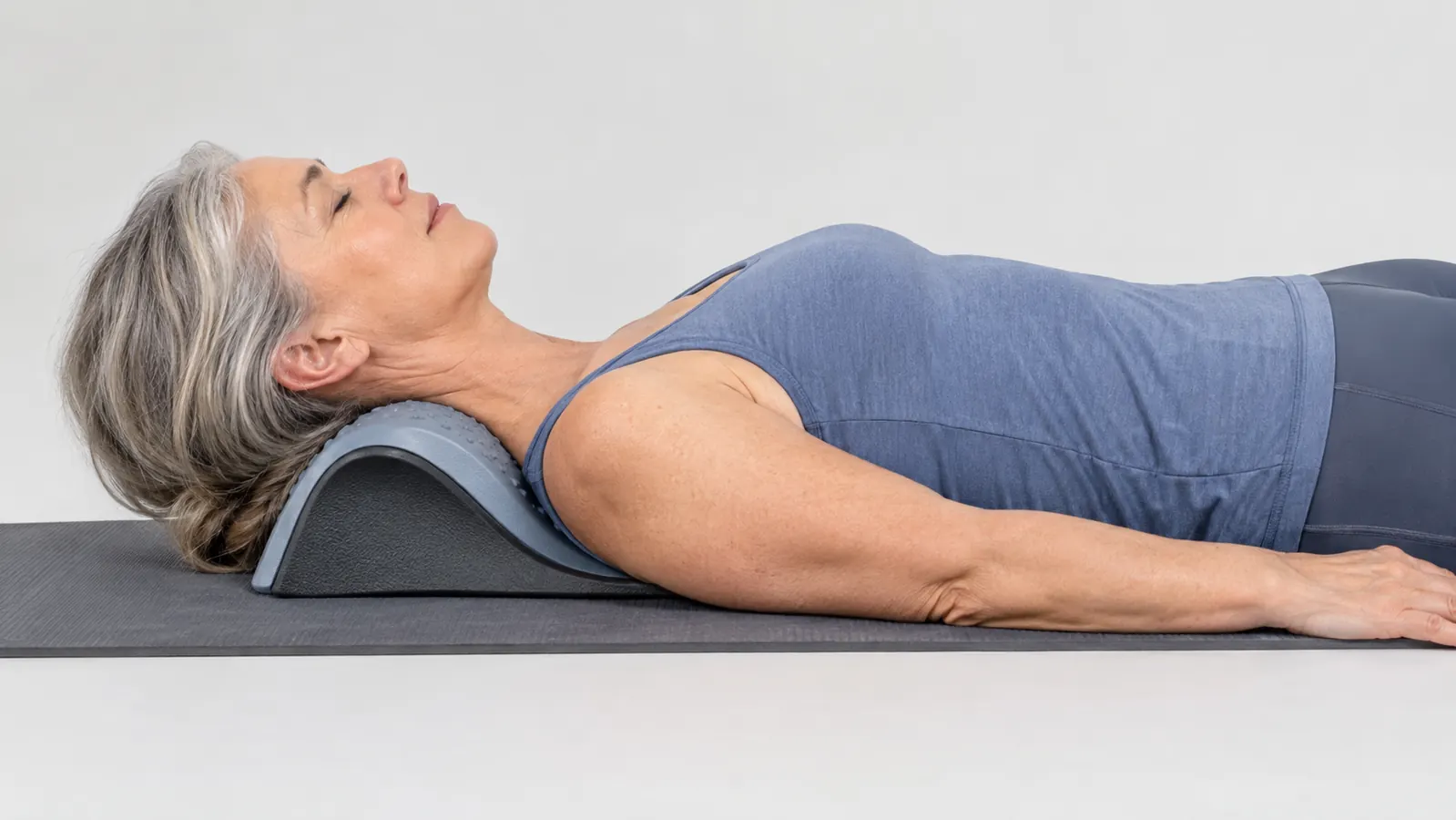
Start with two or three minutes a day. Lie on your back, place the neck stretcher behind your neck, and let your head relax into it. You are not trying to stretch hard. You are giving your neck a chance to rest in a position that is closer to neutral.
After a few days, add a minute or two. I worked my way up to ten minutes most evenings, but only after my neck told me it was ready. The goal is comfort, not a big stretch.
Step 3: Breathe and Let Your Neck Relax
Once you are lying there, do not turn it into a project. I used to tense up and try to feel something happening. That defeats the purpose. Instead, I focus on slow breaths, in through my nose and out through my mouth, and I let my head get heavy.
The RESTCLOUD supports your neck and shoulders in a gentle position, so you do not have to hold anything. Your job is to stay still and breathe. I set a timer on my phone so I do not have to watch the clock.
Some people like to do this before bed. I prefer late afternoon, right after work, because that is when my neck is tightest. Experiment and see what time works for you. The best time is the one you will actually repeat.
Step 4: Pair It With a Small Desk Change
A neck stretcher helps, but it works better when you stop feeding the problem all day. At my front desk, I catch myself leaning toward the computer screen. I moved the monitor up so the top of the screen is close to eye level, and I set a reminder to check my chin position every hour.
You do not need a fancy standing desk. I just adjusted my chair height and moved my keyboard closer so I was not reaching. Small changes add up. The Restcloud is the recovery part of the routine, and the desk setup is the prevention part.
If you work from a laptop in a spare bedroom like I do, prop it up on a stack of books or a laptop stand. I used a thick hardcover book for weeks before I bought anything. It is not glamorous, but it helped.
Step 5: Be Patient and Keep the Routine Boring
Posture habits take years to build, and they take more than a few days to undo. I did not wake up with a perfect neck after one week. What I noticed was smaller: less stiffness on my two-hour drive to Cincinnati to visit my daughter, and fewer times I had to roll my shoulders at the desk.
Keep the routine boring. Same spot, same time, same ten minutes. I do mine while the television is on, and Dave knows not to ask me questions until the timer goes off. That consistency is what made the difference.
Track how you feel, not how you look. If your neck feels easier at the end of the day, that is progress. The RESTCLOUD is a tool, not a promise, and it worked for me because I used it most days.
What to Expect in the First Two Weeks
The first few days, you might notice the back of your neck feels a little tender. That is normal if you have been holding your head forward for years. It is not a reason to stop. Just shorten your session to two minutes and build back up.
By the end of the first week, the routine should feel automatic. By the second week, you may notice your neck feels less stiff after a long day. That was my experience, and it is the reason I kept going. I cannot promise the same timeline for you, but I can promise that ten minutes a day is a small commitment to make for comfort.
One thing that surprised me was how much I came to look forward to those ten minutes. It was the only part of my day when I was not leaning forward, not holding my shoulders up, and not rushing. That mental break may be half the reason it helped.
The first time I used it for ten minutes, the tight spot between my shoulder blades loosened enough that I noticed it on my drive home.

Common Mistakes I Made
The first mistake was using the neck stretcher too long on day one. I mentioned the sore morning already, and it is worth repeating. Start short. Your neck muscles are not used to being supported in a neutral position, and they will complain if you do too much too soon.
The second mistake was holding tension while I lay there. I wanted to feel a stretch, so I kept my shoulders hitched up. That is the opposite of what this tool is for. The whole point is to let go. If you catch yourself tensing, take a breath and relax your shoulders down toward the floor.
The third mistake was expecting a cure. A neck stretcher is not going to erase 26 years of leaning over dental chairs. It is going to make your neck more comfortable if you use it consistently, and that is a realistic goal. I try to judge it by how I feel on my worst days, not by whether I look different in the mirror.
What Else Helps
Neck stretching is one piece of the puzzle. I also do two or three gentle shoulder blade squeezes during the day, and I try to stand up once an hour. Walking around the block at lunch helps more than I expected.
Long drives are the hardest test for my neck. On the way to Cincinnati, I set the cruise control and do a quick chin tuck at every rest stop. It sounds silly, but it keeps me from arriving stiff.
The Restcloud Neck and Shoulder Relaxer is the piece I reach for most, but it is not a replacement for medical care. If you have neck pain that does not improve, or if it gets worse, see a physical therapist or doctor. I am not one, and I do not pretend to be.
One more thing that helped me was keeping a small note card by my monitor with one word on it: chin. Every time I saw it, I pulled my head back over my shoulders. It sounds too simple to matter, but it reminded me dozens of times a day.
When to Check With a Professional
I want to be clear about my limits. I spent 26 years as a dental hygienist, not as a doctor or physical therapist. If your neck pain is sharp, if it does not go away, or if you have been told you have a specific spinal condition, talk to a professional before you add any stretching tool to your routine.
For everyday tightness and forward head posture, a neck stretcher is a reasonable thing to try. Just go in with realistic expectations. It is a comfort tool, not a treatment plan. I use mine because it helps me feel better, not because I expect it to fix everything.
Give It Two Weeks of Ten Minutes a Day
That is the whole plan. Use the Restcloud neck stretcher daily, keep your desk from fighting you, and let your neck rest. Check today's price on Amazon.
Amazon Check Today's Price on Amazon →